My employer, a few months before I was hired, quietly initiated an voluntary environmental management system known as ISO 14001. This past Tuesday, after a week long audit, we have been recommended to be certified as ISO 14001. That is usually just a small formality-for the most part, we can say that we are ISO 14001 certified, or at least, we soon will be, but for the purposes of this blog, I will assume we already are.
We are now the only commercial flooring adhesive manufacturer in the US to be ISO certified. This is HUGE, and I am proud to say that I intend to play a more important role in this program in the future as anyone who knows me knows how much I care about the Earth, the interconnected nature of living things-Gaia, and environmental issues in general. Our environmental policy is straight in line with my personal belief set and green goals-conserving energy, reducing my footprint, becoming self sufficient and striving to live in harmony with nature. I also hope to become more active in the GreenBuilding community in the coming years.
http://www.usgbc.org/
http://www.usgbc.org/DisplayPage.aspx?CMSPageID=222
My dream home is a passive solar earth sheltered home in the back pasture at the ridge line. Green Building, rather, sustainable building, is not new to me. It is a rare find to work in a place where your personal ethics and environmental concerns are shared by upper management. One day soon, our company will be building a new lab and office. I saw the architect's plans and WOW, would you believe that the building will be a LEED certified passive solar building with louvers to control the light and other energy saving features?!? How cool is that?
For those who aren't familiar with ISO 14001, you can learn more from the links below, and hopefully, for the sake of our planet, you can convince your employer and/or your community to follow suit. It can make a real difference, both for your organization, and for the Earth.
http://www.iso.org/iso/management_standards.htm
http://en.wikipedia.org/wiki/ISO_14000
To quote Wiki, "The aim of the standard is to reduce the environmental footprint of a business and to decrease the pollution and waste a business produces."
And this could only be the beginning. We, as a business, could go even further, making even more voluntary changes that would benefit the company's bottom line and the environment. In fact, one such program that we could probably benefit from is called Six Sigma. Motorola invented this strategy for consistent business improvement back in the 1980's, and since then, other large, successful companies like GE and Honeywell have developed Six Sigma programs. It is really all about statistics-(I really, really wish I had taken more statistical studies in college). The Greek letter sigma, "σ" or "Σ", is equivalent to our "s" or "S". Sigma is the mathematical sign for standard deviations and there is a mathematical model that states that if there are six standard deviations between the process mean(the average in a data set) and the nearest specification limit, practically no items will fail to meet specifications. It is a process, and if your business operates within the process, then you will make less errors, 3.4 errors per one million opportunities, to be exact. In other words, if you put a system like this in place, and you make a million products a year, you can expect less than 4 product issues as a result of production or business error per million units. It is actually pretty interesting how far math can take you these days. Who knew that statistics would ever be so important in something other than baseball? ;)
http://en.wikipedia.org/wiki/Six_Sigma
http://www.ge.com/en/company/companyinfo/quality/whatis.htm
It is an insane world. I'm beginning to sound like a broken record, but it sure is nice to work for a company that morally and ethically tries to do what is right. They get it. In a world where no one can agree on the cause of global warming, whether or not it exists, and what should be done about it, if anything, I have found an oasis of green common sense in my workplace. It is refreshing. I only wish I hadn't wandered around in the desert for so long.
Showing posts with label future. Show all posts
Showing posts with label future. Show all posts
Saturday, December 26, 2009

Friday, September 11, 2009
No phone or internet for 60 hours
At 12:30 pm on Tuesday, my phone line went dead. It may not seem like a big deal, but when you live in the boonies, a phone is a lifeline. Many of my neighbors lose service for 3 or 4 days when it rains. My line just gets a lot of static when it is wet outside. The phone lines here are above ground and date probably back to the 1950's, if they are that new. Seriously, in 1996, my neighbors finally lost their party line. You know, a party line is one phone line for several residences that is shared. There is not much privacy on a party line, but that was the way things worked out here. Normal dial-up speed is 56 Kbps. You get that if your city has copper lines and you live reasonably close to the telephone switching office. I have no clue as to the metallic makeup of our antiquated phone lines, but I'd bet that it is not copper, and the fastest I've ever connected is 26 Kbps. The more usual speeds are in the teens. Still, if I have an internet connection, I can check weather and mail, which is important when you are expecting an important email from your future boss.
I think I miss email the most. I can watch television for news and weather in a pinch, it is just not as convenient or specific to my location and needs. I've never been one to chat on the phone, but I do miss hearing from my daughter, and there is a feeling of isolation that is hard to describe. When I was sick, I went for several days without logging on or making phone calls, but I knew it was there. I knew that if I needed to call 911 or someone else to help, that I could. With no phone, there is no help. Most of my neighbors are in the same boat as me. None of us has a cell phone. Of my seven nearest neighbors, only one other couple has a computer. I think they may have a cell phone, but they also have a land-line. Cell phones just don't work in this valley. Almost no one can get a signal strong enough to dial out, and if a phone rings, usually you lose the call when you try to answer.
So when we lose power or telephone service, and need to call in to report such, we have to drive out of the valley to get a signal out-for those who do have a work related cell phone, or find some nearby Good Samaritan who will let you use their phone if they have a working line. Once, I drove 8 miles to the nearest payphone, but now even that phone no longer exists. So, assuming I find a friend a few miles away who has phone service, and call Bellsouth/AT&T to report the outtage. AT&T treats me rudely, acting as if I am a second class citizen because I don't have a cellphone. They assume it is because I can't afford one. They do not believe that there are places where there is no service. They stupidly ask for an email address as a contact, forgetting that when one has dialup, one does not have email access. My elderly neighbors have it worse than I do. All of them are in ill health. The women have suffered heart attacks and strokes, the men have suffered heart attacks and cancer. They NEED 911 service. Today, my neighbor with cancer drove all the way to town to his daughter's house(almost 20 miles) to report the outtage. When he contacted AT&T, he got the same attitude as I did. The neighbor who loses service every time it rains gets even worse treatment. Bellsouth/AT&T does not seem to care that she's had a couple of heart attacks and lives alone. They send people out, each one with a different excuse or reason why she loses service and why it is now fixed after they work on it. Of course, it is only 'fixed' until the next time it rains. Bellsouth/AT&T doesn't seem to care about the poor people who live on this loop. Cell phones are the wave of the future for most of America, so I doubt that Bellsouth/AT&T will even consider spending the money to upgrade the phone lines for the 32 people who live on our road in this pocket valley. We don't matter.
I picked this place for its remoteness and beauty. I seriously doubt we will ever have cable TV, garbage service, county water, pizza delivery, or reliable cell service without a satellite directly overhead. We do have satellite television, and at least one person can afford satellite internet. The cheapest satellite ISP runs about $70/month, and that is the only option other than our 26Kbps dialup, and since most valley residents are of my generation and older, most do not have a computer at all, and if they do, it is certainly hard to afford $70-$100 a month on a fixed income or a rural Georgia income. Why can't the phone company upgrade the lines so that we could have DSL or cable ISP as a part of President Obama's surge to give everyone equal access to phone and internet. I know there are programs for free trackphones, but that wouldn't solve the problem here. Why can't they make a cell phone that can find a satellite or bounce a signal over the ridge to find a cell tower? The people of this valley would just like to have the same service as everyone else. I'd settle for 56K dial-up. Soon, I will have to give up my internet service, not because I can't afford it, but because downloading updates takes days and very often the files are corrupted. I already had to give up Google Earth because I could not download the updates and the program quit working without that update. My Adobe reader has a similar issue and needs upgrading. If the phone rings while the update is downloading, about 50% of the time the file is corrupted. Thunderbird, Mozilla, Adobe, AVG, and other programs update frequently, and when data is transferring at 14 Kbps and the file is 35Mb, you do the math on how long it takes. Realize, too, that even though the math says 840kbpm, the line isn't continuous, and in reality is takes about 5 or 6 minutes to download something that is 1 Megabyte in size. For a 35 MB file, it would take at least 6 hours, and you just hope that no one calls during that time as that corrupts the file.
A long time ago I heard a rumor that this valley might be made into a reservoir for power generation. It would be a small but deep reservoir, 4 miles from the dam end to the opposite end, and about a mile wide. The ridge tops are at 1400 ft and the valley is between 750 and 900 feet. The lake would be several hundred feet deep, and some quick math yields that such a reservoir would hold 6.7x10 11th power, or 6,700,000,000,000 gallons. I guess they decided to use Antioch and Heath Lakes instead and Oglethorpe Power developed a plant 20 miles to the west of here over at Rocky Mountain, which is now a state fishing and recreational area. When I first heard these rumors, I did not give them much thought. Then a few years ago, I read about imminent domain, how the government could come in and basically take your land 'for the public good'. I know my ridges are National Forest and that the government already owns them, but the idea that the Forest Service would annex my land as greenspace or biosphere space still seemed like a remote possibility. Perhaps I have read too many conspiracy theories, but I am beginning to wonder why no utilities or county offices seem to care about our valley. I wonder if they could know something we do not? So I stop and think about what that could be. What could they know? My conspiracy theory got legs a few months ago while watching the news. As it turns out, the Army Corp of Engineers has forbidden the state of Georgia to use the water from Lake Lanier as drinking water. Currently Atlanta and her suburbs, as well as a few other Georgia communities downstream, remove water from the Chattahoochee River and use it as drinking water. Wastewater is treated and returned to the river, which then flows to Alabama and Florida. The Corp has ruled that the massive lake and it's emerging river can only be used by the state of Georgia for recreation, not drinking water. Florida and Alabama have those rights. So,,,,, I ask myself, what will the city of Atlanta do? Would they not be in the market for another reservoir, one they could control without Army CoE involvement, a reservoir that would probably be 3000 acres in size? The ridges that would hold this reservoir are already Federal land, part of the Chattahoochee National Forest. The valley floor is private land and in this day and age, no one would think twice about taking the land via imminent domain for the greater public good. Could that be the reason for the lack of development and repair or maintenance of existing infrastructure like roads and phone lines? I hope not.
I think I miss email the most. I can watch television for news and weather in a pinch, it is just not as convenient or specific to my location and needs. I've never been one to chat on the phone, but I do miss hearing from my daughter, and there is a feeling of isolation that is hard to describe. When I was sick, I went for several days without logging on or making phone calls, but I knew it was there. I knew that if I needed to call 911 or someone else to help, that I could. With no phone, there is no help. Most of my neighbors are in the same boat as me. None of us has a cell phone. Of my seven nearest neighbors, only one other couple has a computer. I think they may have a cell phone, but they also have a land-line. Cell phones just don't work in this valley. Almost no one can get a signal strong enough to dial out, and if a phone rings, usually you lose the call when you try to answer.
So when we lose power or telephone service, and need to call in to report such, we have to drive out of the valley to get a signal out-for those who do have a work related cell phone, or find some nearby Good Samaritan who will let you use their phone if they have a working line. Once, I drove 8 miles to the nearest payphone, but now even that phone no longer exists. So, assuming I find a friend a few miles away who has phone service, and call Bellsouth/AT&T to report the outtage. AT&T treats me rudely, acting as if I am a second class citizen because I don't have a cellphone. They assume it is because I can't afford one. They do not believe that there are places where there is no service. They stupidly ask for an email address as a contact, forgetting that when one has dialup, one does not have email access. My elderly neighbors have it worse than I do. All of them are in ill health. The women have suffered heart attacks and strokes, the men have suffered heart attacks and cancer. They NEED 911 service. Today, my neighbor with cancer drove all the way to town to his daughter's house(almost 20 miles) to report the outtage. When he contacted AT&T, he got the same attitude as I did. The neighbor who loses service every time it rains gets even worse treatment. Bellsouth/AT&T does not seem to care that she's had a couple of heart attacks and lives alone. They send people out, each one with a different excuse or reason why she loses service and why it is now fixed after they work on it. Of course, it is only 'fixed' until the next time it rains. Bellsouth/AT&T doesn't seem to care about the poor people who live on this loop. Cell phones are the wave of the future for most of America, so I doubt that Bellsouth/AT&T will even consider spending the money to upgrade the phone lines for the 32 people who live on our road in this pocket valley. We don't matter.
I picked this place for its remoteness and beauty. I seriously doubt we will ever have cable TV, garbage service, county water, pizza delivery, or reliable cell service without a satellite directly overhead. We do have satellite television, and at least one person can afford satellite internet. The cheapest satellite ISP runs about $70/month, and that is the only option other than our 26Kbps dialup, and since most valley residents are of my generation and older, most do not have a computer at all, and if they do, it is certainly hard to afford $70-$100 a month on a fixed income or a rural Georgia income. Why can't the phone company upgrade the lines so that we could have DSL or cable ISP as a part of President Obama's surge to give everyone equal access to phone and internet. I know there are programs for free trackphones, but that wouldn't solve the problem here. Why can't they make a cell phone that can find a satellite or bounce a signal over the ridge to find a cell tower? The people of this valley would just like to have the same service as everyone else. I'd settle for 56K dial-up. Soon, I will have to give up my internet service, not because I can't afford it, but because downloading updates takes days and very often the files are corrupted. I already had to give up Google Earth because I could not download the updates and the program quit working without that update. My Adobe reader has a similar issue and needs upgrading. If the phone rings while the update is downloading, about 50% of the time the file is corrupted. Thunderbird, Mozilla, Adobe, AVG, and other programs update frequently, and when data is transferring at 14 Kbps and the file is 35Mb, you do the math on how long it takes. Realize, too, that even though the math says 840kbpm, the line isn't continuous, and in reality is takes about 5 or 6 minutes to download something that is 1 Megabyte in size. For a 35 MB file, it would take at least 6 hours, and you just hope that no one calls during that time as that corrupts the file.
A long time ago I heard a rumor that this valley might be made into a reservoir for power generation. It would be a small but deep reservoir, 4 miles from the dam end to the opposite end, and about a mile wide. The ridge tops are at 1400 ft and the valley is between 750 and 900 feet. The lake would be several hundred feet deep, and some quick math yields that such a reservoir would hold 6.7x10 11th power, or 6,700,000,000,000 gallons. I guess they decided to use Antioch and Heath Lakes instead and Oglethorpe Power developed a plant 20 miles to the west of here over at Rocky Mountain, which is now a state fishing and recreational area. When I first heard these rumors, I did not give them much thought. Then a few years ago, I read about imminent domain, how the government could come in and basically take your land 'for the public good'. I know my ridges are National Forest and that the government already owns them, but the idea that the Forest Service would annex my land as greenspace or biosphere space still seemed like a remote possibility. Perhaps I have read too many conspiracy theories, but I am beginning to wonder why no utilities or county offices seem to care about our valley. I wonder if they could know something we do not? So I stop and think about what that could be. What could they know? My conspiracy theory got legs a few months ago while watching the news. As it turns out, the Army Corp of Engineers has forbidden the state of Georgia to use the water from Lake Lanier as drinking water. Currently Atlanta and her suburbs, as well as a few other Georgia communities downstream, remove water from the Chattahoochee River and use it as drinking water. Wastewater is treated and returned to the river, which then flows to Alabama and Florida. The Corp has ruled that the massive lake and it's emerging river can only be used by the state of Georgia for recreation, not drinking water. Florida and Alabama have those rights. So,,,,, I ask myself, what will the city of Atlanta do? Would they not be in the market for another reservoir, one they could control without Army CoE involvement, a reservoir that would probably be 3000 acres in size? The ridges that would hold this reservoir are already Federal land, part of the Chattahoochee National Forest. The valley floor is private land and in this day and age, no one would think twice about taking the land via imminent domain for the greater public good. Could that be the reason for the lack of development and repair or maintenance of existing infrastructure like roads and phone lines? I hope not.
Sunday, September 06, 2009
Hi Ho, Hi Ho, It's Back to Work I Go
It is a done deal. I start back to work on October 1st at XL Brands as their 'Lab Coordinator'. XL makes carpet and flooring adhesives and installation systems. The people seem to be very nice, and it looks to be a well run operation. The lab is much nicer and cleaner than the last place I worked. My working hours are normal daytime working hours with no shift work and no weekends. The company is quite a ways from my house, almost 45 minutes away on the south side of Dalton, but I'm hoping that Skyguy and I can carpool some to take the edge off the gasoline bill. I don't trust gasoline prices to stay low.
XL Brands is a division of Textile Rubber and Chemical Corporation, a global chemical and manufacturing company that is headquartered right up the road in Dalton. The following quote comes from their website: "XL Brands leads the industry with environmentally-safe flooring installation products. We have introduced industry first products that are SCS Certified, (Scientific Certification Systems), and contain PCC, (Post Consumer Content). XL Brands adhesives also care the CRI Green Label Plus seal for indoor air quality." It is so rare to find an adhesives company that is environmentally conscious. That's important to me.
I feel very fortunate and honored. There are so many people out there who are pounding the pavement looking for a good job. I was not looking, and had given up on working again. It is a crazy world and I definitely feel guilty because I know so many people are desperately looking for work. While I had first interviewed with this company over a year ago, nothing became of that and I had written it off as a lost opportunity. Then in July, out of the blue, they called, and I went in for another interview. There have been a couple of other meetings over the last month or so, culminating in yesterday's job offer. I have yet to fill out a job application. It is odd how life can twist and turn. You just never know what might be around the corner.
This will allow us to hopefully pay off debt and complete some projects that have been sitting on the back burner. We will be able to regrade the driveway and fix the ruts; we will be able to replace the bay window in the kitchen before it falls out; we will be able to add insulation to the attic. If President Obama goes through with his Dollars for Dishwashers plan, or whatever he ends up calling it, we might actually be able to afford a new refrigerator this year! Woot! Mostly though , having an additional income takes stress off Skyguy as he changes careers. Money makes him happy. I'm generally not materialistic at all, but I have wanted a jacuzzi for the last 20 years, and I might finally get one. I think I deserve it.
XL Brands is a division of Textile Rubber and Chemical Corporation, a global chemical and manufacturing company that is headquartered right up the road in Dalton. The following quote comes from their website: "XL Brands leads the industry with environmentally-safe flooring installation products. We have introduced industry first products that are SCS Certified, (Scientific Certification Systems), and contain PCC, (Post Consumer Content). XL Brands adhesives also care the CRI Green Label Plus seal for indoor air quality." It is so rare to find an adhesives company that is environmentally conscious. That's important to me.
I feel very fortunate and honored. There are so many people out there who are pounding the pavement looking for a good job. I was not looking, and had given up on working again. It is a crazy world and I definitely feel guilty because I know so many people are desperately looking for work. While I had first interviewed with this company over a year ago, nothing became of that and I had written it off as a lost opportunity. Then in July, out of the blue, they called, and I went in for another interview. There have been a couple of other meetings over the last month or so, culminating in yesterday's job offer. I have yet to fill out a job application. It is odd how life can twist and turn. You just never know what might be around the corner.
This will allow us to hopefully pay off debt and complete some projects that have been sitting on the back burner. We will be able to regrade the driveway and fix the ruts; we will be able to replace the bay window in the kitchen before it falls out; we will be able to add insulation to the attic. If President Obama goes through with his Dollars for Dishwashers plan, or whatever he ends up calling it, we might actually be able to afford a new refrigerator this year! Woot! Mostly though , having an additional income takes stress off Skyguy as he changes careers. Money makes him happy. I'm generally not materialistic at all, but I have wanted a jacuzzi for the last 20 years, and I might finally get one. I think I deserve it.
Monday, August 10, 2009
Onward
What to write about....what to say...
I have lots to say about the things going on in the world, but since I can't change any of those things, there is no use in writing about it, except to say that contrary to what Nancy Pelosi says, I am one of the most patriotic people I know, and it is my right and duty to protest what I feel is a misstep in healthcare legislation.
I've been busy the last week or so, mostly gardening and canning, but also house cleaning and running errands. I may go back to work soon, and I feel unprepared with a zillion loose ends here that need tying. I really thought I would have heard something by now, and I really hate waiting.
The stress of it all has sparked an RA flare-up, and every joint in my body hurts and is stiff. I keep going, else I will be like the tin man and become stiff. When my RA flares like this, I end up totally exhausted because I don't want to sit down at all. It is too hard to get up. So, I channel the Energizer Bunny and head to the garden. I'm no speed demon, but I can get things done. Today, I planted English peas, snow peas, carrots, spinach, radishes, lettuce, and onions. I transplanted Brussel sprouts. Tomorrow, I'll finish sowing my brassicas: broccoli, cauliflower, kale, collards, and cabbage. The seedlings of broccoli and cauliflower are not ready for transplanting yet. Skyguy planted more sweet corn a few days ago. It will be a close call on getting it in before the first frost. In the last week, I've also planted more butternut squashes and a few cukes. Those squashes store really well, so if I can put a few in boxes, I won't be too hungry this winter. You just never know what the future holds with the economy teetering on the edge of disaster. One trucker's strike (Hi Trevor!) or a hurricane which disrupts the gasoline flow again, and the stores will be bare within a few weeks. If we all become home-bound due to swine flu, I'll be glad that I can make a nice, velvety butternut soup to comfort me.
About every three days or so, I can small batches of tomatoes. Because my stove doesn't get that hot anymore, and because I am too lazy to fire up the outdoor propane burner just yet, I've been hot water bath canning in my large, flat-bottomed Dutch oven. I can process 4 pints or 3 quart jars, about half as much as the rippled-bottom canning kettle. Because the Dutch oven heats quickly and more efficiently than the ripple bottom kettle, I can process two batches in the same time as one kettle full, so it doesn't slow me down much. I've canned stewed tomatoes, pizza sauce, plain tomato sauce, and tomato juice. The mixture of this year's tomato varieties has resulted in a very tasty sweet sauce, but the pH is right at 4.0, so it is safe to can. Yeah, the chemist tests sauce pH with pH paper strips-what can I say.
I've never grown sweet peppers. I do not like bell peppers, but I just love chili peppers and devote my garden space to the chilis. However, someone gave us a few banana peppers and they are pretty darn good. They smell like the little hot peppers you get with your Papa Johns pizza(I call those pepperoncini), but they are not hot at all. It is the strangest thing because they smell hot but don't taste hot. They are large, some are 6 inches long, and they look waxy like Hungarian Wax Chilis. I'm not quite sure what to do with them. Should I slice them and pickle them as pepper rings, or should I cut them into strips and maybe freeze them for use on pizzas??? Decisions, decisions. I may have to save the seeds from these-they are definitely interesting and not what I am used to eating. I wonder if they are really supposed to be hotter, but due to some soil condition or some other variable, they are super mild? Could that be?
Change of subject...
Snakes are crawling here in valley. Skyguy hit a big timber rattler on the way home from work a few days ago. He drove on home, picked me up, and we went back up the road to get a better look. That puppy had 11 rattles and a button and was as large as my arm. There was another dead snake on the road near here that was almost as large as the one Skyguy hit and killed. There seems to be a lot of snakes this year, but perhaps it is just that the neighbor's logging and tree thinning has stirred them up. The machinery and logging is in an area known for legendary-sized rattlesnakes. Habitat destruction is real and local.
I have lots to say about the things going on in the world, but since I can't change any of those things, there is no use in writing about it, except to say that contrary to what Nancy Pelosi says, I am one of the most patriotic people I know, and it is my right and duty to protest what I feel is a misstep in healthcare legislation.
I've been busy the last week or so, mostly gardening and canning, but also house cleaning and running errands. I may go back to work soon, and I feel unprepared with a zillion loose ends here that need tying. I really thought I would have heard something by now, and I really hate waiting.
The stress of it all has sparked an RA flare-up, and every joint in my body hurts and is stiff. I keep going, else I will be like the tin man and become stiff. When my RA flares like this, I end up totally exhausted because I don't want to sit down at all. It is too hard to get up. So, I channel the Energizer Bunny and head to the garden. I'm no speed demon, but I can get things done. Today, I planted English peas, snow peas, carrots, spinach, radishes, lettuce, and onions. I transplanted Brussel sprouts. Tomorrow, I'll finish sowing my brassicas: broccoli, cauliflower, kale, collards, and cabbage. The seedlings of broccoli and cauliflower are not ready for transplanting yet. Skyguy planted more sweet corn a few days ago. It will be a close call on getting it in before the first frost. In the last week, I've also planted more butternut squashes and a few cukes. Those squashes store really well, so if I can put a few in boxes, I won't be too hungry this winter. You just never know what the future holds with the economy teetering on the edge of disaster. One trucker's strike (Hi Trevor!) or a hurricane which disrupts the gasoline flow again, and the stores will be bare within a few weeks. If we all become home-bound due to swine flu, I'll be glad that I can make a nice, velvety butternut soup to comfort me.
About every three days or so, I can small batches of tomatoes. Because my stove doesn't get that hot anymore, and because I am too lazy to fire up the outdoor propane burner just yet, I've been hot water bath canning in my large, flat-bottomed Dutch oven. I can process 4 pints or 3 quart jars, about half as much as the rippled-bottom canning kettle. Because the Dutch oven heats quickly and more efficiently than the ripple bottom kettle, I can process two batches in the same time as one kettle full, so it doesn't slow me down much. I've canned stewed tomatoes, pizza sauce, plain tomato sauce, and tomato juice. The mixture of this year's tomato varieties has resulted in a very tasty sweet sauce, but the pH is right at 4.0, so it is safe to can. Yeah, the chemist tests sauce pH with pH paper strips-what can I say.
I've never grown sweet peppers. I do not like bell peppers, but I just love chili peppers and devote my garden space to the chilis. However, someone gave us a few banana peppers and they are pretty darn good. They smell like the little hot peppers you get with your Papa Johns pizza(I call those pepperoncini), but they are not hot at all. It is the strangest thing because they smell hot but don't taste hot. They are large, some are 6 inches long, and they look waxy like Hungarian Wax Chilis. I'm not quite sure what to do with them. Should I slice them and pickle them as pepper rings, or should I cut them into strips and maybe freeze them for use on pizzas??? Decisions, decisions. I may have to save the seeds from these-they are definitely interesting and not what I am used to eating. I wonder if they are really supposed to be hotter, but due to some soil condition or some other variable, they are super mild? Could that be?
Change of subject...
Snakes are crawling here in valley. Skyguy hit a big timber rattler on the way home from work a few days ago. He drove on home, picked me up, and we went back up the road to get a better look. That puppy had 11 rattles and a button and was as large as my arm. There was another dead snake on the road near here that was almost as large as the one Skyguy hit and killed. There seems to be a lot of snakes this year, but perhaps it is just that the neighbor's logging and tree thinning has stirred them up. The machinery and logging is in an area known for legendary-sized rattlesnakes. Habitat destruction is real and local.
Friday, July 31, 2009
Future Shock or Just Getting Old
Alvin Toffler, in Future Shock, predicted this would happen, but he didn't tell me that I would feel old and worry about having early onset Alzheimers. You see, I'm having trouble keeping up with technology. I know I am not alone, but I feel alone. At some point in life, I must have decided to turn my back on it and I just haven't kept up with things. For example, I have no clue what Blue Ray is, or what 3G or 4G means. I don't suppose I'll ever own a cell phone, um, Blackberry or iPhone. I've never texted anything, never received a text. I've never surfed the internet on anything but my desktop computer, never had a laptop even. Never had a Mac or an Apple...brother in law partitioned a drive for me and I had Linux at one time, but there just weren't any apps for it back then, so I went back to Windows. It takes more than 7 minutes for my Facebook home page to load, and I can't chat from it. Point is, even my experience on popular sites like Facebook is not what others experience. I can't watch video - no YouTube. I don't have a web cam for Skype. I'm really not even sure how that works, or if it would even work, connecting as slow as I do. No iPod, no Mp3 music or podcasts, never done it because of my connection speed. It is getting to the point where I almost can't get updates for the programs I have. These companies forget that dialup users have a hard time downloading a 15 meg update. I just got a Windows update. Even leaving the computer online all night long, it took all day yesterday and last night and this morning...24 hours..I have no idea of how large the update was, but whatever. 18 kbps download speed....Woohoo!
Long ago, I stopped looking at vehicles. I couldn't tell the difference between a Honda or Chevy. All the cars kind of look the same to me. People say, "I saw you on such and such road and waved-didn't you see me?" Of course, I don't look at other cars, just the road, so I never see anyone. I'm really nearsighted, which also plays a part in not noticing friends or family in oncoming cars. If I do make them out in passing, it is too late to wave, so people think I'm snobby or angry.
I'm out of it in more ways, too. Just for kicks, I googled the Billboard top 100 and top 50 singles. Out of 150 entries, I recognized 28 artists(some duplicated like the Black Eyed Peas) and two songs (Boom Boom Pow, Kiss A Girl). This poor showing from someone who used to know even the most obscure group on the top 100. When and how did this happen? I swore to myself when I was 15 that I would NEVER ignore pop music-that if nothing else, I would at least know the most popular artists and songs, the top 40, etc.
At my last job, I worked with this boy genius kid who knew more about Excel and spreadsheets in general than anyone I've ever known. Today's 20 something kids have been taught about these useful programs and software apps in school, whereas, my generation was forced to learn on our own. It is no wonder that people my age can't find a job. We are dinosaurs. I'm a chemist, but even the periodic table is different now than it was when I was in school. Experimental physics and polymer chemistry has changed everything in industry and manufacturing. When I was in school, polymer chemistry was a chapter or two in your Organic Chemistry class. Now, you can major in polymer chemistry.
I kept my granddaughter on a recent Saturday. I used to think that I would have a lot to offer her in the way of knowledge and wisdom. I did graduate college with a 3.94/4.0 GPA. I consider myself intelligent, and yet, I wonder if my knowledge will be relevant by the time Jordan is old enough to understand things. Will she appreciate Nature, or will she become a city girl who would rather be shopping at the local mall? Will she care about what I think if, in her eyes, I am old and irrelevant and not 'with it'? Already, my advice to my daughter concerning finances doesn't make sense as I write checks and keep paper records and she banks and pays bills electronically. Will Jordan even want to visit me here, where there are bugs and mosquitoes? What do I have to offer? Will she be so bored she hates the place when she can't get her Tweets or Texts?
In a homesteading, subsistence lifestyle, one doesn't have a need to watch anything on Blue Ray. One doesn't really even need television. It is optional. My field peas don't need a podcast, and I can hear the rooster at 4 in the morning just fine without 4G. Still, I wonder.
Future Shock was written in 1970, I believe, but it is very relevant today. It is worth reading if you have never read it, and worth a reread if it has been a while since you did. If you are like me, you have forgotten a lot.
Long ago, I stopped looking at vehicles. I couldn't tell the difference between a Honda or Chevy. All the cars kind of look the same to me. People say, "I saw you on such and such road and waved-didn't you see me?" Of course, I don't look at other cars, just the road, so I never see anyone. I'm really nearsighted, which also plays a part in not noticing friends or family in oncoming cars. If I do make them out in passing, it is too late to wave, so people think I'm snobby or angry.
I'm out of it in more ways, too. Just for kicks, I googled the Billboard top 100 and top 50 singles. Out of 150 entries, I recognized 28 artists(some duplicated like the Black Eyed Peas) and two songs (Boom Boom Pow, Kiss A Girl). This poor showing from someone who used to know even the most obscure group on the top 100. When and how did this happen? I swore to myself when I was 15 that I would NEVER ignore pop music-that if nothing else, I would at least know the most popular artists and songs, the top 40, etc.
At my last job, I worked with this boy genius kid who knew more about Excel and spreadsheets in general than anyone I've ever known. Today's 20 something kids have been taught about these useful programs and software apps in school, whereas, my generation was forced to learn on our own. It is no wonder that people my age can't find a job. We are dinosaurs. I'm a chemist, but even the periodic table is different now than it was when I was in school. Experimental physics and polymer chemistry has changed everything in industry and manufacturing. When I was in school, polymer chemistry was a chapter or two in your Organic Chemistry class. Now, you can major in polymer chemistry.
I kept my granddaughter on a recent Saturday. I used to think that I would have a lot to offer her in the way of knowledge and wisdom. I did graduate college with a 3.94/4.0 GPA. I consider myself intelligent, and yet, I wonder if my knowledge will be relevant by the time Jordan is old enough to understand things. Will she appreciate Nature, or will she become a city girl who would rather be shopping at the local mall? Will she care about what I think if, in her eyes, I am old and irrelevant and not 'with it'? Already, my advice to my daughter concerning finances doesn't make sense as I write checks and keep paper records and she banks and pays bills electronically. Will Jordan even want to visit me here, where there are bugs and mosquitoes? What do I have to offer? Will she be so bored she hates the place when she can't get her Tweets or Texts?
In a homesteading, subsistence lifestyle, one doesn't have a need to watch anything on Blue Ray. One doesn't really even need television. It is optional. My field peas don't need a podcast, and I can hear the rooster at 4 in the morning just fine without 4G.
Future Shock was written in 1970, I believe, but it is very relevant today. It is worth reading if you have never read it, and worth a reread if it has been a while since you did. If you are like me, you have forgotten a lot.
Tuesday, July 28, 2009
Food in the Future
My new friend Dave has asked my opinion of the prediction of higher energy and food costs, possible shortages ahead, etc. All I can say is that I believe that to be true with every ounce of my being. I've long believed that we would see much hardship in my lifetime. I've tried to prepare by living simply, learning skills, and being frugal. I grow and preserve what I can, we hunt and fish, and we try to live close to the land. I've tried to learn about native plants and herbs in the event that medicines are scarce or non-available. For a while, I raised dairy goats and learned to make cheese and process milk. We've raised rabbits, pigs, goats, sheep and all manner of critters except cattle. Many people have asked why I don't sell my farm products, and the simple answer is that people will not pay enough to offset costs. I justify my own costs with the knowledge that I know what I am eating, how it was grown or raised, etc. I think I eat healthier than most people, even though I eat a fat-laden diet. I know that I am not poisoning myself with pesticides or herbicides.
The plight of farmers is all over the news. California may have happy cows, but the farmers are going out of business. Equipment costs, testing, transportation, and the cost of growing food for the cows all add up to drive the cost of a gallon of milk through the roof. Patented seed and chemicals have made Monsanto et. al. rich and left farmers poor. The rising price of oil and fuel has put a hurtin' on large agribusiness farmers who need specialized equipment to grow and harvest crops, and on the the truckers who transport the food to the processor and then on to grocery stores.
It is a no-brainer that we are headed for hard times. When I was born, the world population was about 3 billion, the US population was about 180 million, and the population of the county that I grew up in was 114,000. Today, world population is 6.6 billion+, US population is about 300 million+, and Cobb County has about 700,000 people. My local population increased five fold, and the world population doubled. By contrast, natural resources are diminishing, not growing. It is a train wreck that will have a gory outcome, and no one wants to think about it. To make matters worse, I believe there will be people, an elite class, that profit from the suffering of the general population. I believe that the decline has already begun. And no, I don't th ink it has much to do with politics or any particular politician. It is a global problem that no one is trying in earnest to solve. The only thing I can do is to try to reduce my dependence on utilities and purchased goods and live close to the vest. The Earth cannot afford too many of us living extravagantly, and far too many people in this country live above their means, which in the end will only increase their suffering. We have chosen a home away from city conveniences, a home that is modest and heated only by wood. Our water is from a well, and we protect the well because it is the life-blood of this land. Georgia and Tennessee are already battling over Georgia's claim to a spot on the Tennessee River, and that is child's play compared to western states' battles over water. I think, in my lifetime, we will see wars fought over water rights and development rights for production of electricity. Water rights are already a key issue in solving the Palestinian/Israeli conflict. It is a problem which will only get worse. Yeah, I believe that food shortages are coming.
The plight of farmers is all over the news. California may have happy cows, but the farmers are going out of business. Equipment costs, testing, transportation, and the cost of growing food for the cows all add up to drive the cost of a gallon of milk through the roof. Patented seed and chemicals have made Monsanto et. al. rich and left farmers poor. The rising price of oil and fuel has put a hurtin' on large agribusiness farmers who need specialized equipment to grow and harvest crops, and on the the truckers who transport the food to the processor and then on to grocery stores.
It is a no-brainer that we are headed for hard times. When I was born, the world population was about 3 billion, the US population was about 180 million, and the population of the county that I grew up in was 114,000. Today, world population is 6.6 billion+, US population is about 300 million+, and Cobb County has about 700,000 people. My local population increased five fold, and the world population doubled. By contrast, natural resources are diminishing, not growing. It is a train wreck that will have a gory outcome, and no one wants to think about it. To make matters worse, I believe there will be people, an elite class, that profit from the suffering of the general population. I believe that the decline has already begun. And no, I don't th
 ink it has much to do with politics or any particular politician. It is a global problem that no one is trying in earnest to solve. The only thing I can do is to try to reduce my dependence on utilities and purchased goods and live close to the vest. The Earth cannot afford too many of us living extravagantly, and far too many people in this country live above their means, which in the end will only increase their suffering. We have chosen a home away from city conveniences, a home that is modest and heated only by wood. Our water is from a well, and we protect the well because it is the life-blood of this land. Georgia and Tennessee are already battling over Georgia's claim to a spot on the Tennessee River, and that is child's play compared to western states' battles over water. I think, in my lifetime, we will see wars fought over water rights and development rights for production of electricity. Water rights are already a key issue in solving the Palestinian/Israeli conflict. It is a problem which will only get worse. Yeah, I believe that food shortages are coming.
Wednesday, July 22, 2009
Non-trivial Science related Trivia
I have this list of useless, but interesting random trivia, so for something different, I thought I would share the list with you. As you might expect, most have a science bent....Big surprise on that one as you all know, Bev is Earth.
Pavement on land creates "expressways" for oil and other pollutants to run into the ocean. "Every eight months, nearly 11 million gallons of oil run off our streets and driveways into our waters -- the equivalent of the Exxon Valdez oil spill," --- from the Pew Oceans Commission in 2003
That's why I like my gravel driveway. Yeah, it is rut filled and gets the vehicles muddy, but at least I know that my pollutants stay here and do not become someone else's problem downstream in the watershed.
The quest of alchemists—to change base metals into gold—was achieved to a certain degree in Soviet nuclear reactors, where radioactivity transformed some lead nuclei into gold.
The largest reservoirs of gold on Earth, about 10 billion tons, are the oceans. Unfortunately, there is no practical way to get it out. Gold is also plentiful elsewhere in the solar system. In 1999, the NEAR spacecraft showed that a single asteroid, Eros, contains more gold than has ever been mined on Earth.
That's a WOW from me. I heard the other day on TV that all the gold ever mined in the history of human mining would fill only two Olympic sized swimming pools. Same show informed me that a gold bar weighs about 27 pounds.
Kevlar, superglue, cellophane tape, Teflon, Post-it notes, photographs, and the phonograph: All were laboratory blunders. Chinese alchemists were trying to make an elixir of immortality and made gunpowder instead.
Speaking of Kevlar... the International Space Station is covered with a foot-thick blanket of Kevlar to protect it from over 100,000 meteoroids that will slam into it over a 20 year period. Of course, every day, up to 4 billion meteoroids fall to Earth, most of them insanely small, but you never know when a killer rock might slip in undetected.
Life on earth began about 3.8 billion years ago, but sex did not evolve until more than 2 billion years later. Asexual reproduction is a better evolutionary strategy in many important ways, so it is unclear why sexual reproduction developed.
The hermaphroditic earthworm Dendrobaena rubida has both male and female genitalia. If it cannot find a mate, the worm doubles up so that its female bits and male bits can go to town.
Some fish and reptiles can 'change sex'. In marine environments near coral reefs, most fish change sex at least once in their life, and they can have both male and female organs at the same time, like the worm.
Homosexual behavior is found in at least 1,500 species of mammal, fish, reptile, bird, and even invertebrates.
In the animal world, there doesn't seem to be a choice, just an adaption. Nature wins.
Burials in America deposit 827,060 gallons of embalming fluid, formaldehyde, methanol, and ethanol, into the soil each year. Cremation pumps dioxins, hydrochloric acid, sulfur dioxide, and carbon dioxide into the air.
Americans generate 472 billion pounds of trash every year, including 96 billion pounds of food trash—more than 300 pounds per person, wasted.
Food waste is only 2 percent of the total waste. The rest is industrial refuse, including mine tailings, agricultural waste, construction debris, and chemicals
One quart of motor oil, improperly disposed of, can pollute 250,000 gallons of drinking water.
WOW!
Each year, consumers in the United States spread 300 million pounds of chemical insecticides, including compounds that the EPA says may impair the nervous system, disrupt hormones in the body, or cause cancer.
Not me, not me-I'm getting greener all the time!
Landfills are actually the No. 1 human-generated source of methane, belching 7 million tons into the atmosphere each year.
Those poor cows and pigs have really gotten a bum rap.
Fresh Kills Landfill on Staten Island in New York, which closed in 2001, is the world's largest city dump, covering about 2,200 acres
Pavement on land creates "expressways" for oil and other pollutants to run into the ocean. "Every eight months, nearly 11 million gallons of oil run off our streets and driveways into our waters -- the equivalent of the Exxon Valdez oil spill," --- from the Pew Oceans Commission in 2003
That's why I like my gravel driveway. Yeah, it is rut filled and gets the vehicles muddy, but at least I know that my pollutants stay here and do not become someone else's problem downstream in the watershed.
The quest of alchemists—to change base metals into gold—was achieved to a certain degree in Soviet nuclear reactors, where radioactivity transformed some lead nuclei into gold.
The largest reservoirs of gold on Earth, about 10 billion tons, are the oceans. Unfortunately, there is no practical way to get it out. Gold is also plentiful elsewhere in the solar system. In 1999, the NEAR spacecraft showed that a single asteroid, Eros, contains more gold than has ever been mined on Earth.
That's a WOW from me. I heard the other day on TV that all the gold ever mined in the history of human mining would fill only two Olympic sized swimming pools. Same show informed me that a gold bar weighs about 27 pounds.
Kevlar, superglue, cellophane tape, Teflon, Post-it notes, photographs, and the phonograph: All were laboratory blunders. Chinese alchemists were trying to make an elixir of immortality and made gunpowder instead.
Speaking of Kevlar... the International Space Station is covered with a foot-thick blanket of Kevlar to protect it from over 100,000 meteoroids that will slam into it over a 20 year period. Of course, every day, up to 4 billion meteoroids fall to Earth, most of them insanely small, but you never know when a killer rock might slip in undetected.
Life on earth began about 3.8 billion years ago, but sex did not evolve until more than 2 billion years later. Asexual reproduction is a better evolutionary strategy in many important ways, so it is unclear why sexual reproduction developed.
The hermaphroditic earthworm Dendrobaena rubida has both male and female genitalia. If it cannot find a mate, the worm doubles up so that its female bits and male bits can go to town.
Some fish and reptiles can 'change sex'. In marine environments near coral reefs, most fish change sex at least once in their life, and they can have both male and female organs at the same time, like the worm.
Homosexual behavior is found in at least 1,500 species of mammal, fish, reptile, bird, and even invertebrates.
In the animal world, there doesn't seem to be a choice, just an adaption. Nature wins.
Burials in America deposit 827,060 gallons of embalming fluid, formaldehyde, methanol, and ethanol, into the soil each year. Cremation pumps dioxins, hydrochloric acid, sulfur dioxide, and carbon dioxide into the air.
Americans generate 472 billion pounds of trash every year, including 96 billion pounds of food trash—more than 300 pounds per person, wasted.
Food waste is only 2 percent of the total waste. The rest is industrial refuse, including mine tailings, agricultural waste, construction debris, and chemicals
One quart of motor oil, improperly disposed of, can pollute 250,000 gallons of drinking water.
WOW!
Each year, consumers in the United States spread 300 million pounds of chemical insecticides, including compounds that the EPA says may impair the nervous system, disrupt hormones in the body, or cause cancer.
Not me, not me-I'm getting greener all the time!
Landfills are actually the No. 1 human-generated source of methane, belching 7 million tons into the atmosphere each year.
Those poor cows and pigs have really gotten a bum rap.
Fresh Kills Landfill on Staten Island in New York, which closed in 2001, is the world's largest city dump, covering about 2,200 acres
Sunday, July 19, 2009
Midsummer Garden Happenings
It's been a few weeks since I gave a garden update, and now I have to subject you to a really long post. I apologize. I'll try to get some pics up soon.
We've been quite busy around here with the garden, canning, dog training, etc. This past weekend, we also kept our granddaughter. I'm trying to take it easy and follow the doctor's orders, but it is hard. The sutures are gone, but I still have to elevate my foot 50% of the time, 30 minutes for every hour I am up. Worse still, I can't wear normal shoes yet and am still in the surgical shoe. The incision is healing nicely; there's a nice, raised, hard ridge at the site. The pain is really minimal, more in my pinky toe itself than in the joint for whatever reason. At least now I can take a shower, swim, etc. I've haven't done any heavy garden work, mostly picking beans and such. Skyguy has been picking veggies, watering, monitoring for bugs, staking tomatoes, etc. He tilled a patch and planted more okra, too. I'm really quite impressed with his gardening.
Anyway, I just want to ride my bike. I've gained back about 12 pounds of what I lost, and I am not happy about it. I really should have dieted, but dang, when you are laid up, you get bored, and boredom leads to eating!
Bed 1 is a hodgepodge of plants. I did not get cages around my tomatoes early, so they, like kudzu, have sprawled over the bed and they are taking over! I have about 3 romas and a serrano pepper, a poblano pepper, butternut squash, two eggplants and probably something else in that bed that is lost under the vines. At the east end of that bed, there are a few blue lake bean seeds that have not germinated. That raised bed is next to the chicken run, and in the foot wide space between the bed and the run I've planted sorghum which is about 12 feet tall and almost mature. I've already bend some of the canes over into the chicken run to feed the chooks on the fly.
Bed 2 just has dill in it right now after I pulled up and harvested all of the cauliflower that was in it previously. It was not a good year for cauliflower, but I did get a few meals out of it. I'll replant soon.
Bed 3 has a couple of toms, a butternut squash, and blue lake bush beans that are just coming up. There is a tomatillo volunteer and two Anaheim peppers.
There is nothing in bed 4. I'm hoping it will be ready to plant in the Spring.
Bed 5 has one very large and sprawling yellow crookneck squash and some Tendercrop green beans that are just starting to flower.
Bed 6 is empty and won't be planted until late 2010
Now, for the in ground plants:
Peanuts: I only had about 20% germination, but I left them alone hoping to at least get enough nuts to roast for a snack. If I am lucky, I might get enough for one jar of peanut butter. I had hoped to get enough for 4 jars, but a vole or mouse or something ate the nuts. They are just now flowering, so it will be a while before I can use that space.
I have another large crookneck squash in the ground, as well as a zucchini, and all of my squashes, both winter and summer, are doing great. I've been diligently killing squash bug eggs and it is paying off. For winter squashes I have planted butternut and acorn squashes inside and outside the garden fence in various places. I'm hoping to fill up at least one laundry basket of each type. For the summer squashes, we grill them fresh, I freeze some, and I make squash
casseroles and freeze those. I also make squash bread from both zukes and yellow squash-no use wasting the big ones, I just grate them up and then make and freeze the bread. It is a banana bread recipe, but I sub 2 cups of grated squash for the bananas. I make loaf pans and muffins that I can freeze and eat later for breakfast and snack food.
We are starting to get some okra(Dwarf Lee is the variety) and we have just planted Clemson Spineless. Since it is Skyguys's first year in the garden, he wanted to grow what everyone else grows, so we have hybrid corn, a hybrid tomato, and the Clemson Spineless....
The strawberries are going like gangbusters, but they are a bit smaller than I would like. I think they need fertilizer and water. Even so, they are tasty and I'm picking a bit more than a pint a day. All 3 grapevines(Remailly seedless, Catawba, Mars seedless) have multiple clusters of grapes, and I've been picking blueberries for a week now. The blackberries are in the freezer already. It looks to be a good apple year, but I don't see but a few pears and no plums. In hills
around the garden, in addition to the winter squashes, I have a few pickling cukes, a couple of Georgia rattlesnake watermelons, and scads of sweet potatoes. I hope to have a laundry basket of sweet potatoes as well.
I planted a 10x12 patch of small, teeny-tiny red field peas the way my friend James suggested. I scuffed up the ground, hand cast the peas, and covered them with waste hay. The peas came up great, and they still look great. It takes about 100 days for these peas, and I am right at Day 85. Next year, I'll grow more peas and black beans this way.
I've got 3 areas of corn. The first group was sweet corn planted just after Easter. This corn really has not produced, tassled at only 2 feet tall. No one around here that planted corn early has any-it was a bad year for early corn-too much rain early on, I think. We got a few stunted ears which were delicious, but we only got a few meals instead of being able to load the freezer. However, as bad as the early corn was, the late corn was good. I had a beautiful stand of Bloody Butcher corn that was 6ft tall or more until late last week when a summer thunderstorm downburst flattened it. I'm crushed. I tried to stand it backup, but the canes just broke. I planted this corn deeper than usual, about 2 inches deep, just to prevent this problem, but to no avail. I'm hoping that there is enough corn left standing to at least regain my seed. Corn plot #3 is another plot of hybrid, Early and Often, that Skyguy planted in a dog kennel out behind the barn to keep the distance from the other corn and to protect it from the deer. It is doing well- about 2 feet tall now. This is not the first time I've lost corn to thunderstorms and lodging. I've planted deeper, I've hilled up around the plants..I've ruled out rootworms. I just don't know what else to do. Obviously, my garden spot, which is just a few hundred feet downwind of a ridge, is where the storms dump their downbursts. The storms are uplifted by the western side of the ridge, but once the storm crosses the ridge line, the mountain starts to break them up and in the process they dump wind in a downburst or straight lines. The ridge protects us from super cell storms, but this is the downside of it. Skyguy wants to try allowing the corn to grow up through cattle panel placed waste high, but I don't know. It seems rather silly-no one else does it, but, really, I'm ready to try odd things to save the corn. Maybe I should grow it in small plots and put posts on the corners and then run string around it and through it to support the stalks. Maybe growing it in hills would be better. At least with a 3 sisters style arrangement in a hill, I would not get the domino effect of toppling corn like I saw in the block. I'm open for suggestions. Help.
Sunday, I pulled up, peeled, blanched and froze carrots. I julienned some for salads and stirfries, and I used the small ends in some pickled jalapenos for color. I'm going to try and replant the tops, too. I need to now amend the 12 foot long bed and add some soil and in a few weeks I will replant more carrots. There are a few chard plants left in that bed, and I'll cut them back, too. In addition to more carrots, I'll plant some radishes and beets. Also next week, I'll move some cattle panels around and resow some snow peas, turnips, and English peas for the Fall.
Also on Sunday I canned some jalapeno peppers with some carrots. Soon, we will make cucumber pickles. I grew up with a certain kosher dill pickle recipe, but Skyguy wants to experiment to see if we can find something more crisp. We bought one of those Mrs. Wages mixes, and I'll make a pint plain, and then mix and match the ingredients to see what he will like and think works best. Some jars will have grape leaves, some will have garlic, some will have dill heads, some will have dill seed and weed, and some will have all of the above. I already know that the jars with everything in it will be my favorites, but he wasn't raised in a canning/gardening family and he is enjoying the experimentation of it all, so since we have plenty of cukes, why not? Some of the best discoveries in the world were accidents. Viagra did not help the angina of Welsh miners, but hey, we all know what is does help!
Beans...I've got a million beans, but because I was trying to get rid of old seeds, I have a little bit of a lot of things. Some were old and had poor germination, some just did not provide enough plants. Long story shorter, I haven't canned or frozen any beans yet, but we are eating good every night. I did give some away, too. We've planted the equivalent of a 100 ft row or more of blue lake bush beans and they are just now breaking ground so two months from now, I should be able to can beans. I'm still getting beans, but that should wane over the next few weeks. The wax beans are in a lull, the Roma II bush beans are waning, the KY wonder pole beans are hitting stride, the yard long beans are starting to flower, and the Royal Burgundy bush beans will be ready to pick within the week. It's a lot of beans.
And now, the tomatoes....finally, I am starting to get some ripe cherry toms. Some of the Romas are ripening, but only one of the slicing toms is getting ripe and that is Skyguy's Better Boy. However, in a week or so, definitely by two weeks, I will be canning and making tomato products. I expect to be doing that for the next month or so. I've started washing mason jars and getting everything ready. I washed and sterilized the Victorio strainer, a device I use to make the paste and sauces. It's a good thing. I don't even know how many tomato plants I have -more than 50- and probably 60% of them are paste types(Roma, Sausage, Oxheart, etc), 10% are cherry(Super Sweet 100 and Husky Red Cherry), and the rest are slicers/sandwich tomatoes (Brandywines, Caspian pinks, Mortgage Lifter, Abraham Lincoln etc.). I'll be making tomato sauce, tomato paste, tomato juice, V8 juice, pizza sauce, spaghetti sauce, chili base, and a bit of salsa in addition to stewed toms. I still have some salsa from last year, but I might make a bit if I get overrun with peppers. I'd really rather dry the serranos as I use those in guacamole.
Speaking of guacamole, I've started about 7 or 8 avocado trees. I know I won't get avocados here, but hey, they make nice houseplants and I can always hope for a miracle. Who knows what global warming will do, right? There's got to be an upside to it, and if I could grow avocados, I'd be super happy!
It is time to plant and plan for the Fall crops, and I started that Saturday. I planted the following in those little peat pots to be transplanted later:
72 broccoli plants-Green Goliath-a new variety I am trying
25 cabbage plants-Danish Ballhead-seeds are from 2007-yikes
25 Brussel Sprouts-Catskill-it's the last time I'll try growing Brussel Sprouts..I mean it this time.
22 Red onions, with more to be planted in the ground in mid August
Next week, I'll plant Snow peas, English peas, radishes and carrots. The other big job I need to do is to dig potatoes. I have different varieties in multiple places that would amount to about a thirty foot row. I really hope that the Yukon Gold produced well.
Mid August, I'll plant more carrots collards, kale, beets, salad greens, spinach, turnips(both the root and the greens), Osaka purple mustard, and of course the brassicas and plants I sowed today will go to the ground. Neither of us have ever eaten kale, but I'm hoping it will be a green we can harvest all winter. Skyguy is the one who wants all of these Southern greens...I personally don't care for collards or turnips(the greens are okay though), and I like beet greens better than mustard, but we are trying to find things that we can harvest in the winter that we both like and that would be healthy for us. At some point after that, I will sow some Aquadulce Fava beans as a cover crop in the spot where I'll grow corn next year.
A month or so ago, I planted a seed packet of Artichokes. There were 8 seeds in the pack, and I got 7 plants to transplant size. Unfortunately, between the heat, the puppy, the chicken, and just bad luck, I only have one plant left. I'll be sowing more, I think. I've grown fond of artichoke hearts and perennial vegetables are king!
The other major garden venture that we have in the works is a plan to expand the asparagus bed. Now that Skyguy eats it, we need more, so I'll be tilling and double digging an area near the water line to the barn, along the outside of the garden fence-essentially a 50 foot double row. The water line presents a problem in the initial dig-I'll have to be super careful, but it should not hamper the asparagus' growth and the extra mulch feeding in the fall should help insulate the PVC water line from the cold.
So that's the plan!
We've been quite busy around here with the garden, canning, dog training, etc. This past weekend, we also kept our granddaughter. I'm trying to take it easy and follow the doctor's orders, but it is hard. The sutures are gone, but I still have to elevate my foot 50% of the time, 30 minutes for every hour I am up. Worse still, I can't wear normal shoes yet and am still in the surgical shoe. The incision is healing nicely; there's a nice, raised, hard ridge at the site. The pain is really minimal, more in my pinky toe itself than in the joint for whatever reason. At least now I can take a shower, swim, etc. I've haven't done any heavy garden work, mostly picking beans and such. Skyguy has been picking veggies, watering, monitoring for bugs, staking tomatoes, etc. He tilled a patch and planted more okra, too. I'm really quite impressed with his gardening.
Anyway, I just want to ride my bike. I've gained back about 12 pounds of what I lost, and I am not happy about it. I really should have dieted, but dang, when you are laid up, you get bored, and boredom leads to eating!
Bed 1 is a hodgepodge of plants. I did not get cages around my tomatoes early, so they, like kudzu, have sprawled over the bed and they are taking over! I have about 3 romas and a serrano pepper, a poblano pepper, butternut squash, two eggplants and probably something else in that bed that is lost under the vines. At the east end of that bed, there are a few blue lake bean seeds that have not germinated. That raised bed is next to the chicken run, and in the foot wide space between the bed and the run I've planted sorghum which is about 12 feet tall and almost mature. I've already bend some of the canes over into the chicken run to feed the chooks on the fly.
Bed 2 just has dill in it right now after I pulled up and harvested all of the cauliflower that was in it previously. It was not a good year for cauliflower, but I did get a few meals out of it. I'll replant soon.
Bed 3 has a couple of toms, a butternut squash, and blue lake bush beans that are just coming up. There is a tomatillo volunteer and two Anaheim peppers.
There is nothing in bed 4. I'm hoping it will be ready to plant in the Spring.
Bed 5 has one very large and sprawling yellow crookneck squash and some Tendercrop green beans that are just starting to flower.
Bed 6 is empty and won't be planted until late 2010
Now, for the in ground plants:
Peanuts: I only had about 20% germination, but I left them alone hoping to at least get enough nuts to roast for a snack. If I am lucky, I might get enough for one jar of peanut butter. I had hoped to get enough for 4 jars, but a vole or mouse or something ate the nuts. They are just now flowering, so it will be a while before I can use that space.
I have another large crookneck squash in the ground, as well as a zucchini, and all of my squashes, both winter and summer, are doing great. I've been diligently killing squash bug eggs and it is paying off. For winter squashes I have planted butternut and acorn squashes inside and outside the garden fence in various places. I'm hoping to fill up at least one laundry basket of each type. For the summer squashes, we grill them fresh, I freeze some, and I make squash
casseroles and freeze those. I also make squash bread from both zukes and yellow squash-no use wasting the big ones, I just grate them up and then make and freeze the bread. It is a banana bread recipe, but I sub 2 cups of grated squash for the bananas. I make loaf pans and muffins that I can freeze and eat later for breakfast and snack food.
We are starting to get some okra(Dwarf Lee is the variety) and we have just planted Clemson Spineless. Since it is Skyguys's first year in the garden, he wanted to grow what everyone else grows, so we have hybrid corn, a hybrid tomato, and the Clemson Spineless....
The strawberries are going like gangbusters, but they are a bit smaller than I would like. I think they need fertilizer and water. Even so, they are tasty and I'm picking a bit more than a pint a day. All 3 grapevines(Remailly seedless, Catawba, Mars seedless) have multiple clusters of grapes, and I've been picking blueberries for a week now. The blackberries are in the freezer already. It looks to be a good apple year, but I don't see but a few pears and no plums. In hills
around the garden, in addition to the winter squashes, I have a few pickling cukes, a couple of Georgia rattlesnake watermelons, and scads of sweet potatoes. I hope to have a laundry basket of sweet potatoes as well.
I planted a 10x12 patch of small, teeny-tiny red field peas the way my friend James suggested. I scuffed up the ground, hand cast the peas, and covered them with waste hay. The peas came up great, and they still look great. It takes about 100 days for these peas, and I am right at Day 85. Next year, I'll grow more peas and black beans this way.
I've got 3 areas of corn. The first group was sweet corn planted just after Easter. This corn really has not produced, tassled at only 2 feet tall. No one around here that planted corn early has any-it was a bad year for early corn-too much rain early on, I think. We got a few stunted ears which were delicious, but we only got a few meals instead of being able to load the freezer. However, as bad as the early corn was, the late corn was good. I had a beautiful stand of Bloody Butcher corn that was 6ft tall or more until late last week when a summer thunderstorm downburst flattened it. I'm crushed. I tried to stand it backup, but the canes just broke. I planted this corn deeper than usual, about 2 inches deep, just to prevent this problem, but to no avail. I'm hoping that there is enough corn left standing to at least regain my seed. Corn plot #3 is another plot of hybrid, Early and Often, that Skyguy planted in a dog kennel out behind the barn to keep the distance from the other corn and to protect it from the deer. It is doing well- about 2 feet tall now. This is not the first time I've lost corn to thunderstorms and lodging. I've planted deeper, I've hilled up around the plants..I've ruled out rootworms. I just don't know what else to do. Obviously, my garden spot, which is just a few hundred feet downwind of a ridge, is where the storms dump their downbursts. The storms are uplifted by the western side of the ridge, but once the storm crosses the ridge line, the mountain starts to break them up and in the process they dump wind in a downburst or straight lines. The ridge protects us from super cell storms, but this is the downside of it. Skyguy wants to try allowing the corn to grow up through cattle panel placed waste high, but I don't know. It seems rather silly-no one else does it, but, really, I'm ready to try odd things to save the corn. Maybe I should grow it in small plots and put posts on the corners and then run string around it and through it to support the stalks. Maybe growing it in hills would be better. At least with a 3 sisters style arrangement in a hill, I would not get the domino effect of toppling corn like I saw in the block. I'm open for suggestions. Help.
Sunday, I pulled up, peeled, blanched and froze carrots. I julienned some for salads and stirfries, and I used the small ends in some pickled jalapenos for color. I'm going to try and replant the tops, too. I need to now amend the 12 foot long bed and add some soil and in a few weeks I will replant more carrots. There are a few chard plants left in that bed, and I'll cut them back, too. In addition to more carrots, I'll plant some radishes and beets. Also next week, I'll move some cattle panels around and resow some snow peas, turnips, and English peas for the Fall.
Also on Sunday I canned some jalapeno peppers with some carrots. Soon, we will make cucumber pickles. I grew up with a certain kosher dill pickle recipe, but Skyguy wants to experiment to see if we can find something more crisp. We bought one of those Mrs. Wages mixes, and I'll make a pint plain, and then mix and match the ingredients to see what he will like and think works best. Some jars will have grape leaves, some will have garlic, some will have dill heads, some will have dill seed and weed, and some will have all of the above. I already know that the jars with everything in it will be my favorites, but he wasn't raised in a canning/gardening family and he is enjoying the experimentation of it all, so since we have plenty of cukes, why not? Some of the best discoveries in the world were accidents. Viagra did not help the angina of Welsh miners, but hey, we all know what is does help!
Beans...I've got a million beans, but because I was trying to get rid of old seeds, I have a little bit of a lot of things. Some were old and had poor germination, some just did not provide enough plants. Long story shorter, I haven't canned or frozen any beans yet, but we are eating good every night. I did give some away, too. We've planted the equivalent of a 100 ft row or more of blue lake bush beans and they are just now breaking ground so two months from now, I should be able to can beans. I'm still getting beans, but that should wane over the next few weeks. The wax beans are in a lull, the Roma II bush beans are waning, the KY wonder pole beans are hitting stride, the yard long beans are starting to flower, and the Royal Burgundy bush beans will be ready to pick within the week. It's a lot of beans.
And now, the tomatoes....finally, I am starting to get some ripe cherry toms. Some of the Romas are ripening, but only one of the slicing toms is getting ripe and that is Skyguy's Better Boy. However, in a week or so, definitely by two weeks, I will be canning and making tomato products. I expect to be doing that for the next month or so. I've started washing mason jars and getting everything ready. I washed and sterilized the Victorio strainer, a device I use to make the paste and sauces. It's a good thing. I don't even know how many tomato plants I have -more than 50- and probably 60% of them are paste types(Roma, Sausage, Oxheart, etc), 10% are cherry(Super Sweet 100 and Husky Red Cherry), and the rest are slicers/sandwich tomatoes (Brandywines, Caspian pinks, Mortgage Lifter, Abraham Lincoln etc.). I'll be making tomato sauce, tomato paste, tomato juice, V8 juice, pizza sauce, spaghetti sauce, chili base, and a bit of salsa in addition to stewed toms. I still have some salsa from last year, but I might make a bit if I get overrun with peppers. I'd really rather dry the serranos as I use those in guacamole.
Speaking of guacamole, I've started about 7 or 8 avocado trees. I know I won't get avocados here, but hey, they make nice houseplants and I can always hope for a miracle. Who knows what global warming will do, right? There's got to be an upside to it, and if I could grow avocados, I'd be super happy!
It is time to plant and plan for the Fall crops, and I started that Saturday. I planted the following in those little peat pots to be transplanted later:
72 broccoli plants-Green Goliath-a new variety I am trying
25 cabbage plants-Danish Ballhead-seeds are from 2007-yikes
25 Brussel Sprouts-Catskill-it's the last time I'll try growing Brussel Sprouts..I mean it this time.
22 Red onions, with more to be planted in the ground in mid August
Next week, I'll plant Snow peas, English peas, radishes and carrots. The other big job I need to do is to dig potatoes. I have different varieties in multiple places that would amount to about a thirty foot row. I really hope that the Yukon Gold produced well.
Mid August, I'll plant more carrots collards, kale, beets, salad greens, spinach, turnips(both the root and the greens), Osaka purple mustard, and of course the brassicas and plants I sowed today will go to the ground. Neither of us have ever eaten kale, but I'm hoping it will be a green we can harvest all winter. Skyguy is the one who wants all of these Southern greens...I personally don't care for collards or turnips(the greens are okay though), and I like beet greens better than mustard, but we are trying to find things that we can harvest in the winter that we both like and that would be healthy for us. At some point after that, I will sow some Aquadulce Fava beans as a cover crop in the spot where I'll grow corn next year.
A month or so ago, I planted a seed packet of Artichokes. There were 8 seeds in the pack, and I got 7 plants to transplant size. Unfortunately, between the heat, the puppy, the chicken, and just bad luck, I only have one plant left. I'll be sowing more, I think. I've grown fond of artichoke hearts and perennial vegetables are king!
The other major garden venture that we have in the works is a plan to expand the asparagus bed. Now that Skyguy eats it, we need more, so I'll be tilling and double digging an area near the water line to the barn, along the outside of the garden fence-essentially a 50 foot double row. The water line presents a problem in the initial dig-I'll have to be super careful, but it should not hamper the asparagus' growth and the extra mulch feeding in the fall should help insulate the PVC water line from the cold.
So that's the plan!
Thursday, July 16, 2009
Survival of the Sickest, Part II-Diabetes
More about Survival of the Sickest...
The Younger Dryas period of extreme cold, coming just at the end of our last ice age, began in less than 10 years and ended in less than 3 years. That is what is called sudden onset of climate change. This was proven using ice cores and other methods. The present 'stable' climate of the last 11000 years is the exception in our climate history, not the rule. Change happens quickly, so how did humans adapt in such a short period of time? If human evolution takes millions of years, how has our species survived series after series of sudden climate change when grasslands turned into glaciers in a matter of a few years. The answer could be simple: Diabetes mellitis.
In diabetes, the body excretes water and dumps sugar into the blood, exactly the response seen in nature by plants and animals who are attempting to survive the cold. Grapes do it, Frogs do it, and humans do it. Almost everyone has the urge to pee when they have to go out in the cold. That's the body's way of reducing water, because water freezes and destroys cells. Less water, less ice crystals. Also, sugar lowers the freezing point of blood. Saline also lowers the freezing point.
When you are faced with abrupt cold, you shiver. The body robs the muscles of stored sugars and the friction generates heat, then capillaries restrict blood flow to the extremities, reserving the blood for the body core. Certain ethnic groups who live near the poles, like the Inuit and the Sami, have adapted and developed what is called a Hunters response, meaning that every few minutes, the capillaries dilate and allow the blood to flow to the extremities to prevent frostbite and damage, then restrict themselves again. These groups of people have adapted so that their capillary response is much quicker than those peoples who live in more temperate zones. Those who hail from more equatorial zones lack the response entirely. Polar peoples also have a larger quantity of brown fat cells, cells that don't store fat, but burn it to generate heat. The combination of these small adaptions could allow a human to hunt and forage longer in the cold, a skill that might allow survival to reproductive age.
Maybe, just maybe, those who are genetically predisposed to diabetes are those descended from places where there was a sudden advance of the ice sheets in the Younger Dryas period 13000 years ago? Diabetes may have helped certain groups survive the last ice age. There is definitely a cold link to the disease. More diabetes is diagnosed in the colder months-between November and February in the northern hemisphere. Children with Type I are usually diagnosed when the temps drop in the Fall of the year.
Adaption is a two way street. Natural selection chooses a technique that will allow the organism to survive an immediate threat, BUT, the adaption may weaken the organism in other areas. For example, peacock feathers make him more attractive to females, but also make him more obvious to predators.
The Younger Dryas period of extreme cold, coming just at the end of our last ice age, began in less than 10 years and ended in less than 3 years. That is what is called sudden onset of climate change. This was proven using ice cores and other methods. The present 'stable' climate of the last 11000 years is the exception in our climate history, not the rule. Change happens quickly, so how did humans adapt in such a short period of time? If human evolution takes millions of years, how has our species survived series after series of sudden climate change when grasslands turned into glaciers in a matter of a few years. The answer could be simple: Diabetes mellitis.
In diabetes, the body excretes water and dumps sugar into the blood, exactly the response seen in nature by plants and animals who are attempting to survive the cold. Grapes do
 it, Frogs do it, and humans do it. Almost everyone has the urge to pee when they have to go out in the cold. That's the body's way of reducing water, because water freezes and destroys cells. Less water, less ice crystals. Also, sugar lowers the freezing point of blood. Saline also lowers the freezing point.
When you are faced with abrupt cold, you shiver. The body robs the muscles of stored sugars and the friction generates heat, then capillaries restrict blood flow to the extremities, reserving the blood for the body core. Certain ethnic groups who live near the poles, like the Inuit and the Sami, have adapted and developed what is called a Hunters response, meaning that every few minutes, the capillaries dilate and allow the blood to flow to the extremities to prevent frostbite and damage, then restrict themselves again. These groups of people have adapted so that their capillary response is much quicker than those peoples who live in more temperate zones. Those who hail from more equatorial zones lack the response entirely. Polar peoples also have a larger quantity of brown fat cells, cells that don't store fat, but burn it to generate heat. The combination of these small adaptions could allow a human to hunt and forage longer in the cold, a skill that might allow survival to reproductive age.
Maybe, just maybe, those who are genetically predisposed to diabetes are those descended from places where there was a sudden advance of the ice sheets in the Younger Dryas period 13000 years ago? Diabetes may have helped certain groups survive the last ice age. There is definitely a cold link to the disease. More diabetes is diagnosed in the colder months-between November and February in the northern hemisphere. Children with Type I are usually diagnosed when the temps drop in the Fall of the year.
Adaption is a two way street. Natural selection chooses a technique that will allow the organism to survive an immediate threat, BUT, the adaption may weaken the organism in other areas. For example, peacock feathers make him more attractive to females, but also make him more obvious to predators.
Survival of the Sickest: Part I
My daughter Kate has similar tastes in books as I do. We like non-fiction, but it needs an edge so it is not too dry of a read. This time, Kate has loaned me a 2007 book by Dr. Sharon Moalem, called Survival of the Sickest. It is a good read, but then again, I like things like this-hypotheses that make sense, have some scientific evidence to support them, but are not totally proven or accepted as fact. To me, this is the fun of science-it is the big 'What If' that allows you to wonder about coincidences and explore connections between seemingly odd things. I believe that there are no coincidences in life, and I believe that all things are connected.
"DNA isn't destiny, it's history", writes Moalem, and that quote reminds me of a co nversation I had a while back with my friend James, who is oft irritated by those who use genetic predisposition as an excuse for continuing unhealthy behaviors and lifestyles. Moalem's quote is important to remember. We have to study history so as not to repeat it, but just because history tends to repeat itself doesn't mean that the future is locked in. When it comes to disease, there are so many variables and triggers that it is possible to be predisposed to a disease and have a high probability of contracting it, but never actually contracting it because one lived a life avoiding the potential or known genetic triggers, like smoking or eating a diet low in fiber, etc. Later in the book, when discussing epigenetics, Moalem writes "DNA is destiny--until you get out the old methyl Magic Marker and start rewriting it." You see, it is actually possible to change your DNA by your actions. What you do can initiate certain genes, formerly thought of as junk DNA, now thought of as jumping genes, to fasttrack mutations and speed up evolution. So yeah, Lamarckian was correct after all and the concept of jumping genes, while not fully understood, can explain things like why a small percentage of Australian Shepherds are now being born with naturally docked tails, and why some lizards are born with larger bodies and tails if the mother smells a certain snake while she is pregnant, versus a small bodied lizard if no danger is sensed. Scariest of all, is that my smoking habit may have switched on cancer genes for my daughter AND granddaughter, even if they never smoke. Get this: since I smoked when I was pregnant with my daughter, and she was born with every egg she will have, essentially, my cells passed epigenetic signals to my granddaughter while she was still an egg in my daughter's ovary, while my daughter was still a fetus inside of me. This stuff is wild, and it goes to show that Heinlein was right and the universe is not just stranger than we imagine, it is stranger than we can imagine.
At any rate, the book is about history, genetics, and human evolution, and it is fascinating. He starts off by talking about the disease called hemochromatosis then moves on to diabetes, then blood lipids. I took notes because I am increasing suffering from CRS, a middle age affliction known colloquially as Can't Remember Sh*t. I won't spoil the entire book, but in this post, I do want to talk about his first talking point-the relationship between iron and disease and how that may have helped mankind survive.
Hemochromatosis is a disease where the body locks up and stores iron. Yes, iron i 
s a good thing, but too much iron can cause organ damage. The body has chelators, proteins which lock up iron, and they are very important in the immune response. Egg white, albumin, is full of chelators, as is breast milk. Bacteria multiply unimpeded in iron rich environments, so if you can bind up iron, as chelators do, you can starve bacteria and allow the immune system's other defenses to work.
Bubonic plague affects lymphatic system, causing glands to swell and even rupture through the skin...survival rate is 33% Airborne plague has a survival rate of 10% Those that survived the plague probably had hemochromatosis, a disease where chelating agents lock up iron in the body making it inaccessible to bacteria or were anemic. Today, the hemochromatosis mutation is seen in those whose ancestors came from Western Europe. The downside is that the disease can eventually kill people by the organ damage the iron causes, but because the body's iron is locked away, bacteria starve. The same type of effects are seen in populations that are anemic, like Somali nomads who were exposed to TB, malaria, brucellosis and other diseases, yet did not become sick. In the old days, bloodletting may have helped those with hemochromatosis. It would reduce the iron load. In modern times,people with this disease often give blood more than others. It literally, physically, makes them feel good.
This idea about iron and bacteria requires more study by me. Moalem mention e 
d what he called the Geritol Solution to Global warming. There was an experiment in 1995 near the Galapagos Islands where massive quantities of iron were dumped into the clear blue(basically barren) ocean. The result was that there was an increased phytoplankton growth and the ocean turned green with life. The plankton and bacteria feasted on the iron, and in doing so, sucked carbon dioxide right out of the atmosphere. I'd like to read more about this, but it sur e makes me like the idea of ships as artificial reefs a lot more than I did at one time.
I'll make a few more blog entries on this book, but as a teaser, here's a couple of things you might find interesting:
ACHOO syndrome: Autosomal dominant Compelling Heliopthalmic Outburst syndrome is uncontrollable sneezing when someone is exposed to light after being in the dark...response is a leftover immune response from the days when people lived in caves, and upon emerging into the sunlight, cleared their nasal passages of molds, microbes, etc. that they might have picked up in the cave.
Most adults are lactose intolerance because after a child is weaned, their bodies no longer produce the enzyme that breaks down lactose. People who are descended from tribal or farming communities where animal milk is regularly consumed perhaps have a mutation that allowed continued lactase production after weaning, and therefore would not be lactose intolerant.
"DNA isn't destiny, it's history", writes Moalem, and that quote reminds me of a co
 nversation I had a while back with my friend James, who is oft irritated by those who use genetic predisposition as an excuse for continuing unhealthy behaviors and lifestyles. Moalem's quote is important to remember. We have to study history so as not to repeat it, but just because history tends to repeat itself doesn't mean that the future is locked in. When it comes to disease, there are so many variables and triggers that it is possible to be predisposed to a disease and have a high probability of contracting it, but never actually contracting it because one lived a life avoiding the potential or known genetic triggers, like smoking or eating a diet low in fiber, etc. Later in the book, when discussing epigenetics, Moalem writes "DNA is destiny--until you get out the old methyl Magic Marker and start rewriting it." You see, it is actually possible to change your DNA by your actions. What you do can initiate certain genes, formerly thought of as junk DNA, now thought of as jumping genes, to fasttrack mutations and speed up evolution. So yeah, Lamarckian was correct after all and the concept of jumping genes, while not fully understood, can explain things like why a small percentage of Australian Shepherds are now being born with naturally docked tails, and why some lizards are born with larger bodies and tails if the mother smells a certain snake while she is pregnant, versus a small bodied lizard if no danger is sensed. Scariest of all, is that my smoking habit may have switched on cancer genes for my daughter AND granddaughter, even if they never smoke. Get this: since I smoked when I was pregnant with my daughter, and she was born with every egg she will have, essentially, my cells passed epigenetic signals to my granddaughter while she was still an egg in my daughter's ovary, while my daughter was still a fetus inside of me. This stuff is wild, and it goes to show that Heinlein was right and the universe is not just stranger than we imagine, it is stranger than we can imagine.
At any rate, the book is about history, genetics, and human evolution, and it is fascinating. He starts off by talking about the disease called hemochromatosis then moves on to diabetes, then blood lipids. I took notes because I am increasing suffering from CRS, a middle age affliction known colloquially as Can't Remember Sh*t.

Bubonic plague affects lymphatic system, causing glands to swell and even rupture through the skin...survival rate is 33% Airborne plague has a survival rate of 10% Those that survived the plague probably had hemochromatosis, a disease where chelating agents lock up iron in the body making it inaccessible to bacteria or were anemic. Today, the hemochromatosis mutation is seen in those whose ancestors came from Western Europe. The downside is that the disease can eventually kill people by the organ damage the iron causes, but because the body's iron is locked away, bacteria starve. The same type of effects are seen in populations that are anemic, like Somali nomads who were exposed to TB, malaria, brucellosis and other diseases, yet did
This idea about iron and bacteria requires more study by me. Moalem mention

I'll make a few more blog entries on this book, but as a teaser, here's a couple of things you might find interesting:
ACHOO syndrome: Autosomal dominant Compelling Heliopthalmic Outburst syndrome is uncontrollable sneezing when someone is exposed to light after being in the dark...response is a leftover immune response from the days when people lived in caves, and upon emerging into the sunlight, cleared their nasal passages of molds, microbes, etc. that they might have picked up in the cave.
Most adults are lactose intolerance because after a child is weaned, their bodies no longer produce the enzyme that breaks down lactose. People who are descended from tribal or farming communities where animal milk is regularly consumed perhaps have a mutation that allowed continued lactase production after weaning, and therefore would not be lactose intolerant.
Friday, June 26, 2009
Wishful thinking doesn't make it so...
After my 'Say What??' post, my friend Rob posted a comment suggesting an essay along the same vein, that is long but that I believe is worth your time to read.
http://www.securityaffairs.org/issues/2009/16/peters.php
This line sticks with me, "Even the most successful war yields imperfect results." His example is the Civil War, where slavery was abolished, but equal rights did not come along for another hundred years.
http://www.securityaffairs.org/issues/2009/16/peters.php
This line sticks with me, "Even the most successful war yields imperfect results." His example is the Civil War, where slavery was abolished, but equal rights did not come along for another hundred years.
Sunday, May 31, 2009
Sun stuff
A few months ago I made an entry about the sun, and what a solar storm could do. NOAA made a prediction for the next solar cycle and mentioned the Carrington event in the article:
http://science.nasa.gov/headlines/y2009/29may_noaaprediction.htm
As you can see, the government clearly states that it could take ten years for a rec overy from such an event, so I wasn't exaggerating about what could happen. For me, it is actually quite scary to see this new solar prediction in print. Also in the article is a good graph that clearly illustrates the Maunder Minimum, a time when glaciers expanded and rivers in Europe froze over in what was called the Little Ice Age. I'm sure you've seen the artwork showing ice skaters on the Thames. Scientists still do not know why that happened, and this article and it's graphs make me wonder if we are headed for another 'Maunder Minimum' period, as Gaia struggles to to counter the warming. I think it would be nice to see cooler temperatures and more precipitation, but the longer winters, shorter growing seasons, and possible famine wouldn't be
fun.
Carbon-14 dating in tree rings have shown that there are other 'minima' in r ecent history: Spörer Minimum (1450–1540)and Dalton Minimum (1790–1820). There has actually been 18 periods of sunspot minima in the last 8,000 years, and while some suggest that these periods are caused by a slowing of the sun's rotation, no one knows exactly why that would happen. It is interesting to think about. What we do know is that since 1996, the sun has been getting dimmer and the solar wind is 20% less than what it used to be. In the visible light spectrum, the sun is 0.02% dimmer, but in the ultraviolet spectrum, it is 6% dimmer. Referencing solar activity and sunspots, the sun is quieter now than it has been in the last 100 years. We are in what is referred to as a 'deep solar minimum'.
http://science.nasa.gov/headlines/y2009/29may_noaaprediction.htm
As you can see, the government clearly states that it could take ten years for a rec
 overy from such an event, so I wasn't exaggerating about what could happen. For me, it is actually quite scary to see this new solar prediction in print. Also in the article is a good graph that clearly illustrates the Maunder Minimum, a time when glaciers expanded and rivers in Europe froze over in what was called the Little Ice Age. I'm sure you've seen the artwork showing ice skaters on the Thames. Scientists still do not know why that happened, and this article and it's graphs make me wonder if we are headed for another 'Maunder Minimum' period, as Gaia struggles to to counter the warming. I think it would be nice to see cooler temperatures and more precipitation, but the longer winters, shorter growing seasons, and possible famine wouldn't be
fun.
Carbon-14 dating in tree rings have shown that there are other 'minima' in r
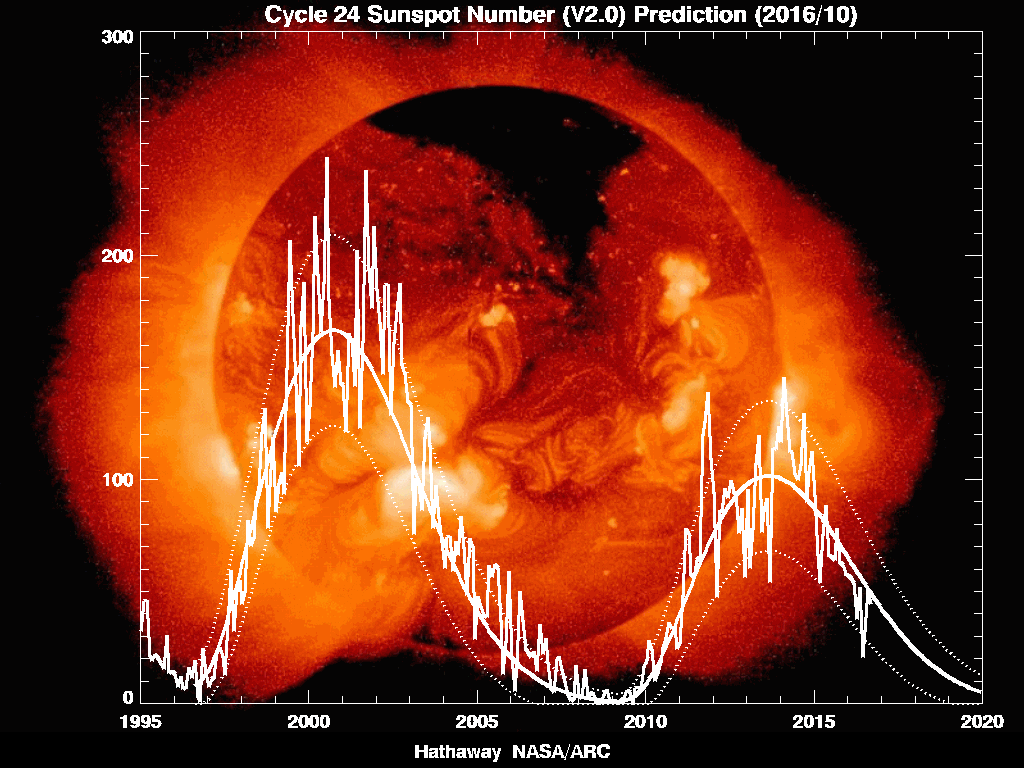 ecent history: Spörer Minimum (1450–1540)and Dalton Minimum (1790–1820). There has actually been 18 periods of sunspot minima in the last 8,000 years, and while some suggest that these periods are caused by a slowing of the sun's rotation, no one knows exactly why that would happen. It is interesting to think about. What we do know is that since 1996, the sun has been getting dimmer and the solar wind is 20% less than what it used to be. In the visible light spectrum, the sun is 0.02% dimmer, but in the ultraviolet spectrum, it is 6% dimmer. Referencing solar activity and sunspots, the sun is quieter now than it has been in the last 100 years. We are in what is referred to as a 'deep solar minimum'.
Saturday, May 16, 2009
Science moving at the speed of light
I have no idea of how many times a day I google for information, but it is more than I should admit to, as I am a person of above average intelligence. I'm old enough to remember when calculators became a handheld device, and people warned how it would cripple our brains and make us lazy. Well, it did, and it didn't. I have a calculator within 2 feet of me, do you?(consider cellphones, etc.) Fast forward to Google and googling information..I used it to remember what movie I saw last-how crazy is that? It just seemed to have better odds of success and faster than looking through my memory box ticket stubs, drawers, calendars, etc. The next generation for nerdy people like me is going to be WolframAlpha.
http://www.wolframalpha.com/
You ask a question, it answers...
If we have the knowledge of all of humanity at our fingertips, what is the next step? The next step is probaby wi-fi chips in your brain that allow instant knowledge. Just today I read an article about an implantable GPS chip with optional cyanide that could be released with a few inputs. Track terrorists, child molestors, criminals, but terminate them before they commit crimes.....of course, that would mean that Big Brother is not only watching, but controlling and manipulating the future by taking out people BEFORE they act, akin to Minority Report. But for now, we just have Wolfram at our fingertips.
It is in the Alpha phase of operation, but it seems to still have Beta like problems. A few minutes ago, I got a message that said "I'm sorry, Dave, I'm afraid I can't do that"...lol...
like all great things that are new, it has a fun factor-it's true uses haven't been realized yet.
http://www.wolframalpha.com/
You ask a question, it answers...
If we have the knowledge of all of humanity at our fingertips, what is the next step? The next step is probaby wi-fi chips in your brain that allow instant knowledge. Just today I read an article about an implantable GPS chip with optional cyanide that could be released with a few inputs. Track terrorists, child molestors, criminals, but terminate them before they commit crimes.....of course, that would mean that Big Brother is not only watching, but controlling and manipulating the future by taking out people BEFORE they act, akin to Minority Report. But for now, we just have Wolfram at our fingertips.
It is in the Alpha phase of operation, but it seems to still have Beta like problems. A few minutes ago, I got a message that said "I'm sorry, Dave, I'm afraid I can't do that"...lol...
like all great things that are new, it has a fun factor-it's true uses haven't been realized yet.
Monday, May 11, 2009
Snakes, Chickens, Sex, and Sermons?
We were able to get the jungle under control this past weekend, but we crossed paths with 2 additional snakes..that makes 3 snakes in two days...one King snake and two red rat(corn) snakes. I was down at my friends house this morning and she showed me a single winding track through the grass-the track was muddy, the grass was green, so it was easy to see. The track was several inches wide. The only thing that would make a track like that is a big rattlesnake, or a monster king snake that just ate the monster rattlesnake(like the one we saw in SC). This track definitely h as a Wow Factor associated with it. The snakes are definitely out and about.
We have a few more roosters to dispatch, but in doing that, we will end the great 2008-2009 hatching project to replace chickens lost to predators. I started with 6 birds, and now have 6+ roos that need to be dispatched, 30 hens and 1 rooster in the main coop, and on e poor battered hen in the chicken tractor. There are 2 or 3 birds in the 30 that might be roosters, too, but right now they are just androgynous pullets. I have a beautiful partridge rock looking roo that I am thinking of keeping. He would be part P artridge Rock(mother) and Blue Laced Red Wyandotte(father). Currently, I have a RIR/BLRW roo. I've forgotten the number of hens a rooster can service, but I think it is somewhere close to 15. I doubt I will keep all the pullets/hens, but I can always raise two flocks separately. I wonder if two roos will fight if there are sufficient hens for both?
I'm quite amazed at the percentage of pullets I hatched vs. roosters/cockerels. I think I've maybe a dozen+ roosters in all the birds I've hatched since Thanksgiving and with close to 70 total birds, that's rather amazing. Even at 15/75-that's only 20% roosters, and I believe the actual percentage is closer to 17%. It's got me wondering about evolution and the 
role temperature plays in determination of sex and embryo development. I know that with some reptiles, noteably crocodilians(alligators, crocs, caimans,and gavial), temperature of the eggs during incubation does influence gender. I believe th at it must be true with some birds, perhaps in my case, the chicken eggs I hatched. The incuba tor temps were kind of high, 100-101F. In some reptiles, higher temps can switch off male expression genes and create females. The embryo starts off as a male, but when the egg is exposed to higher temperatures, the embryo undergoes a gender switch and the hatchling becomes female. In addition, some animals that appear female are actually male and visa versa, i.e. their sex is ambiguous;they are intersexed. Could this have happened with my chickens? I think it is possible. Birds are 
descended from reptiles and the sex change thing is related to a changing environment. Perhap s during warmer eons, more females are produced to expand the population, but during cold er eons, the embryos remain predominantly male. The planet is currently experiencing a warming trend as we all know....is it Nature's Way-the ultimate survival technique-the Master's Plan- to turn males int o females to expand the population while it is warm and to prepare for the cold eon to come? Are my ambiguous, androgynous looking pullets really male?
If this interests you as much as it does me, read this:
http://ourworld.compuserve.com/homepages/dp5/sex2.htm
References are listed at the bottom of the page, but consider this:
If you want a good mental exercise, think about all of this with respect to human evolution, global warming, homosexuality and gender identification. You've probably already figured out that I believe homosexuality, intersexuality, as well as heterosexuality to be natural phenomen 
a. I realize that many of you believe otherwise due to your various faiths, so I don't mean to be disrespectful to your beliefs, but I do believe that there is sufficient scientific evidence and sufficient Biblical contradictory passages to suggest that perhaps we all should have a more open mind to things we don't fully understand or know. I suppose the middle ground we meet on is this:
Matthew 22: 36-40
Love the Lord your God with all your heart and with all your soul and with all your mind.' This is the first and greatest commandment. And the second is like it: 'Love your neighbor as yourself.' All the Law and the Prophets hang on these two commandments.
We have a few more roosters to dispatch, but in doing that, we will end the great 2008-2009 hatching project to replace chickens lost to predators. I started with 6 birds, and now have 6+ roos that need to be dispatched, 30 hens and 1 rooster in the main coop, and on
I'm quite amazed at the percentage of pullets I hatched vs. roosters/cockerels. I think I've maybe a dozen+ roosters in all the birds I've hatched since Thanksgiving and with close to 70 total birds, that's rather amazing. Even at 15/75-that's only 20% roosters, and I believe the actual percentage is closer to 17%. It's got me wondering about evolution and the


If this interests you as much as it does me, read this:
http://ourworld.compuserve.com/homepages/dp5/sex2.htm
References are listed at the bottom of the page, but consider this:
"Sex is relative. Among animals, especially cold-blooded ones, males
can be turned into females by increased feeding or a change in
temperature. In the case of warm-blooded creatures, it can be done by
extracting ovaries to turn, say, a hen into a cock. In many species,
sex reversals happen naturally. Quahogs (hard-shell clams) are born
and grow up male, but later half of them turn female. Slipper shells
and cup and saucer shells do this too; they commence every season as
males, but nearly all of them later pass through a phase of
ambisexuality and turn into adult females.
Fish have evolved the quickest sex-reversing capacity of any animal:
some species not only change from male to female as they grow, but a
few, like groupers and guppies, develop the ability to switch
sexually back and forth within seconds. [ I intentionally picked an image of fancy guppies-quite 'flamboyant', huh?] If two female guppies meet
while feeling amorous, one is likely to start turning into a male so
he can mate with the other. Occasionally both shift at the same
moment, which usually results in a furious fight, with the winner
emerging as a female who somehow forces the other to stay male."
can be turned into females by increased feeding or a change in
temperature. In the case of warm-blooded creatures, it can be done by
extracting ovaries to turn, say, a hen into a cock. In many species,
sex reversals happen naturally. Quahogs (hard-shell clams) are born
and grow up male, but later half of them turn female. Slipper shells
and cup and saucer shells do this too; they commence every season as
males, but nearly all of them later pass through a phase of
ambisexuality and turn into adult females.
Fish have evolved the quickest sex-reversing capacity of any animal:
some species not only change from male to female as they grow, but a
few, like groupers and guppies, develop the ability to switch
sexually back and forth within seconds. [ I intentionally picked an image of fancy guppies-quite 'flamboyant', huh?
while feeling amorous, one is likely to start turning into a male so
he can mate with the other. Occasionally both shift at the same
moment, which usually results in a furious fight, with the winner
emerging as a female who somehow forces the other to stay male."
If you want a good mental exercise, think about all of this with respect to human evolution, global warming, homosexuality and gender identification. You've probably already figured out that I believe homosexuality, intersexuality, as well as heterosexuality to be natural phenomen

Matthew 22: 36-40
Love the Lord your God with all your heart and with all your soul and with all your mind.' This is the first and greatest commandment. And the second is like it: 'Love your neighbor as yourself.' All the Law and the Prophets hang on these two commandments.
Saturday, May 09, 2009
Vacation Post #3: Eco-Diatribe
I’m not one to think that ‘Global Warming’ is 100% man-made. I actually think that we are experiencing natural cycles, terrestrial and solar. That doesn’t absolve humanity from taking responsibility for polluting the Earth, it is just a statement of belief. I know that mankind pollutes every environment possible, but I am not so vain or arrogant to believe that we are more powerful that Mother Earth, Gaia, herself. I believe that Gaia can correct, in time, whatever abuse we dish out. In many ways, the Earth itself acts as an That correction may involve oxidation or crustal subduction, but given enough time, that Gaia will repair herself and erase our very existence if need be. Even if we blow ourselves up and blow the Earth apa
 rt, She will reassemble the fragments and life will reseed the planet. Extremophilic bacteria are everywhere, even in the magma of volcanoes and in the irradiated upper atmosphere, and they will begin diversification. Life will continue, it is a Force-an Energy, but it may not be recognizable or intelligent as such. For Earth, that might even be a good thing. It probably happened in the past. If so, the Earth that existed before a Mars sized body impacted and carved out the Moon did not resemble the Earth of today. We are complex beings, but you could say that we are the embodim
 ent of bacterial diversification and have infected the planet. Whether or not we are a beneficial, benign, or destructive bacteria, we can not know. Whether we are an accident of evolution or have been molded via Intelligent design, we can not know. But I digress….
While on vacation, we visited Hunting Island in South Carolina. It is a state park, located between Edisto and Hilton Head. Native Americans once used the island for hunting, hence the name. It is several miles long and has a lagoon that runs about a third of the island's length. It is beautiful. Like many state parks, there are rental cabins, and on Hunt ing Island, some of these cabins were near the beach. Were. They are gone. In recent years, there has been so much coastal erosion that the cabins were washed away. If you look closely at the pictures, you can see not only the remains of palms and 250 year old live oak trees, but also the concrete corner of an old septic tank-the remains of a cabin. All in all, this only proves that the ocean is changing the face of a barrier island, which is a normal part of island evolution, but it sure gives one pause to think about how we continue to view our changing planet in a snapshot mode and how appropriately powerless we are to subdue the power of the ocean, the power of Mother Earth. Instead of wor
 king in concert with her ebb and flow of energy, we continue to selfishly think only of our own pleasure-we continue to take and try to stop natural Earth changes without thought of the future. The Hunting Island Lighthouse has been moved once, and it may need to be moved again. Without human intervention to restore jetties, install groins and reclaim beaches for recreation, many would have already disappeared and or would have been recreated elsewhere. Perhaps it is time to retreat to the mainland and allow the barrier islands to do their jobs unabated? We often forget that hurricanes and storms are beneficial to the planet as a whole, distributing the heat of the tropics to the temperate regions. If we try to change these processes, then we are ultimately creating our own demise. Humans just need to live more in sync with Nature and stop trying to control it. Click on the pictures to see details. The septic tank is visible in the last picture, and the first image is of the almost tropical lagoon. All of the erosion pictures were taken at low tide. At high tide, the waves would have practically lapped my feet as I stood just above the high tide line.
 we are experiencing natural cycles, terrestrial and solar. That doesn’t absolve humanity from taking responsibility for polluting the Earth, it is just a statement of belief. I know that mankind pollutes every environment possible, but I am not so vain or arrogant to believe that we are more powerful that Mother Earth, Gaia, herself. I believe that Gaia can correct, in time, whatever abuse we dish out. In many ways, the Earth itself acts as an That correction may involve oxidation or crustal subduction, but given enough time, that Gaia will repair herself and erase our very existence if need be. Even if we blow ourselves up and blow the Earth apa
 rt, She will reassemble the fragments and life will reseed the planet. Extremophilic bacteria are everywhere, even in the magma of volcanoes and in the irradiated upper atmosphere, and they will begin diversification. Life will continue, it is a Force-an Energy, but it may not be recognizable or intelligent as such. For Earth, that might even be a good thing. It probably happened in the past. If so, the Earth that existed before a Mars sized body impacted and carved out the Moon did not resemble the Earth of today. We are complex beings, but you could say that we are the embodim
 ent of bacterial diversification and have infected the planet. Whether or not we are a beneficial, benign, or destructive bacteria, we can not know. Whether we are an accident of evolution or have been molded via Intelligent design, we can not know. But I digress….
While on vacation, we visited Hunting Island in South Carolina. It is a state park, located between Edisto and Hilton Head. Native Americans once used the island for hunting, hence the name. It is several miles long and has a lagoon that runs about a third of the island's length. It is beautiful. Like many state parks, there are rental cabins, and on Hunt
 ing Island, some of these cabins were near the beach. Were. They are gone. In recent years, there has been so much coastal erosion that the cabins were washed away. If you look closely at the pictures, you can see not only the remains of palms and 250 year old live oak trees, but also the concrete corner of an old septic tank-the remains of a cabin. All in all, this only proves that the ocean is changing the face of a barrier island, which is a normal part of island evolution, but it sure gives one pause to think about how we continue to view our changing planet in a snapshot mode and how appropriately powerless we are to subdue the power of the ocean, the power of Mother Earth. Instead of wor
 king in concert with her ebb and flow of energy, we continue to selfishly think only of our own pleasure-we continue to take and try to stop natural Earth changes without thought of the future. The Hunting Island Lighthouse has been moved once, and it may need to be moved again. Without human intervention to restore jetties, install groins and reclaim beaches for recreation, many would have already disappeared and or would have been recreated elsewhere. Perhaps it is time to retreat to the mainland and allow the barrier islands to do their jobs unabated? We often forget that hurricanes and storms are beneficial to the planet as a whole, distributing the heat of the tropics to the temperate regions. If we try to change these processes, then we are ultimately creating our own demise. Humans just need to live more in sync with Nature and stop trying to control it. Click on the pictures to see details. The septic tank is visible in the last picture, and the first image is of the almost tropical lagoon. All of the erosion pictures were taken at low tide. At high tide, the waves would have practically lapped my feet as I stood just above the high tide line.
Wednesday, April 01, 2009
The Mother of All Disasters
 One hundred and fifty years ago on August 27, 1859, the world witnessed beautiful auroras that were seen as far south as the equator. This amazing light show continued for eight nights until September 7. In England, Richard Carrington, an amateur astronomer, was one of the first scientists to notice the intensely bright white light originating from a group of sunspots. Carrington also noted that the local magnetometers were erratic and off the scale. (A magnetometer measures the strength and direction of magnetic fields. They are useful in finding buried or submerged objects like shipwrecks or even submarines, and are standard equipment on spacecraft. In 1859, there were magnetometers at telegraph stations because the telegraph operated via electromagnetism.) Carrington correctly correlated this sunspot activity with the geomagnetic anomalies that were being recorded on magnometers as long distance communiques died and telegraph networks failed worldwide. Today, we refer to those eight days in 1859 as the Carrington Event. More recently, in 1989 in Quebec, there was another 'warning' solar event. Then, a brief plasma burst from the sun overwhelmed the power grid and high voltage current created a meltdown of the copper in the grid; Eastern Canada went dark. Luckily the storm was short-lived and US power companies helped restart the Canadian system.
You are probably wondering why the Carrington Event and the Quebec blackout is a big deal. Undoubtedly, the Earth has been bombarded with similar solar storms and we as a people and a planet have come through them just fine. However, if the Carrington Event happened again tomorrow, and it could, it is not an exaggeration to say that millions would die. It would be the planet's worst natural disaster in history.
How could that be in this interconnected global technological age? It is simple; our reliance on technology weakens us for this type of disaster. Here is what actually happens: During periods of increased solar/sunspot activity, the sun's coronal gases spit forth a plasma ball called a Coronal Mass Ejection or CME. CME's hurl through space like a gust of wind, and if they are directed at the Earth, the plasma interacts with the Earth's magnetosphere and atmosphere to create beautiful auroras and if it is powerful enough, some really nasty magnetic effects. To understand CME's, think of a small creek. During normal times, the creek slowly trickles on, like the solar wind does. Sometimes, during dry spells, the creek dries up and there is no flow whatsoever. Sometimes, there are flash floods that appear suddenly and do not last very long. That would be analogous to what happened during the Quebec incident. It was brief in duration and regional in effect. Sometimes, the flooding raises the water level and the flood continues for days. That would be analogous to the Carrington Event. As the Earth spun around, it was bombarded continuously by the CME from the sun, and telegraphs around the world were disabled as the storm lasted eight days.
The first casualties of an Earth directed CME will be satellites that are in Earth orbit. The plasma blasts disrupt gyroscopes on satellites making them unable to maintain orbital position. Once they lose Earth-lock, they lose the ability to transmit data, and there is no way scientists on the ground can communicate with the satellite, so they have to be abandoned. Secondly, high energy atomic particles bombard and fry electrical systems. Finally, as the upper atmosphere heats up from the plasma bombardment, the density of the lower atmosphere changes and that creates drag on satellites. Any or all of these things can happen to varying degrees in solar storms. Satellites would begin tumbling and would quickly lose orbital height. Communications would be lost. If GPS satellites are lost, oil platforms, aircraft navigation, cell phones, and other equipment that use GPS would become useless. The loss of communications and global positioning satellites alone would be an economic disaster. Solar disturbances wreak havoc on satellites quite frequently, much like earthquakes cause damage on Earth. However, one day, we will experience another Carrington Event-the equivalent of The Big One.
Within a minute and a half of the plasma burst hitting the atmosphere, power grids would fail from high energy particles like electrons overloading the lines which will heat up and melt essential grid hubs. In North America, there are about 300 key transformer hubs and if they are lost, the continental grid fails. These large currents will travel through the system like a massive lightning bolt, frying the electronics of anything not hardened in a Faraday cage. The world now relies so heavily on technology that the loss of power and equipment would have devastating consequences. Without power for control, drinking water treatment plants, sewage pumping stations, gasoline stations, supermarket refrigeration, medical equipment and other vital equipment will become non-functional.
Financial markets will plummet and the world's economy will flip-flop with the most technologically dependent countries taking the worst fall. For safety reasons, power plants are programmed to shut down with grid disruptions, so until the physical grid itself is restored, there would be no power generation. Nothing would change for months, probably years as melted transformers and hubs can only be replaced, not repaired. The few spare transformers kept in reserve would quickly be used, It takes a year to make one, and with high demand worldwide, obtaining more transformers would be nearly impossible in the short term. Government studies have suggested that if a large CME disabled the power grid in the United States, that power might not be restored for 4 to 10 years. YEARS.
Even when some systems are capable of receiving power again, there is no guarantee there will be any electricity to deliver. Almost all natural gas and fuel pipelines require electricity to operate. Coal-fired power stations usually keep coal reserves to last 30 days, but they rely on trains for coal delivery, and of course the trains are dependent on GPS and electrical switching and fuel pumping. Nuclear plants would be taken off line for safety reasons during the first minutes of the storm when the grid was lost and would be locked out until a consistent power source could be restored. After a period of say five years and millions of deaths, would there even be enough trained and knowledgeable people to operate the equipment?
Within minutes of the initial power loss, people would realize that without electricity, there is no clean drinking water or sewer service. That would soon lead to bacterial diseases like cholera and dysentery. Within a few days, there would be no food in the stores, because due to the inability to pump gasoline, no deliveries are made. Backup generators for medical care would last a few days, but after that, medical care loses 150 years of progress without lighting, lasers, sanitizers, diagnostic and monitoring equipment, etc. etc. With only rudimentary medical treatment, untold numbers would die. Of course, there would be no power for heating, cooling, or industry. After a few weeks, the supplies of medicine would run out, and without industry, there would be no way of making more or delivering the supplies where they are needed. In the course of several years, millions would die-from accidents and disease, from starvation and exposure, from criminal acts, and probably from war.
Other developed countries would be equally reduced to third world status. China's power grid system is even at a higher risk of failure due to the way the voltage is regulated, and European countries are so interdependent that a domino effect would incapacitate the continent almost immediately. The internet would survive in a diminished capacity, but only the military and governments would have hardened assets and battery capability to exchange information on a global scale. During solar storms, even shortwave radio is not reliable.
In the best of all possible worlds, our only hope is the ACE solar orbiting satellite(Advanced Composition Explorer) which could possibly give us 15 to 45 minutes of warning, depending on the speed of the ejection and the position of the satellite. If power companies have 15 minutes of warning, they can sometimes prevent damage or at least attempt to isolate grids to prevent a cascading loss. The problem is that ACE is already operating beyond it's expected lifespan-it was launched to study the solar wind back in 1997-and as it ages, it's detectors become less sensitive. It was not designed to measure a massive plasma ejection. The second and more serious problem is that previous large CME's, like the ones that precipitated the Carrington Event and the Quebec grid failure, traveled much faster than anticipated and arrived at Earth in less than 10 minutes. Even if ACE had been out there during those CME's, it would detect the particles, but not provide enough warning time to power companies or satellite controllers to take emergency measures.
In the worst of all possible worlds, the CME comes during a period of heightened solar activity, like what is projected to occur in 2012, near the Spring or Fall equinox. At the time of the equinoxes, Earth is oriented in such a way that the protective magnetic field is weakened and vulnerable to plasma strikes. Also, during this time of year, there is little demand for heating and cooling- it is 'off peak' if you will, and computers monitor the equipment on the grid. It is a time of year when manpower is minimal and should a spike occur, there may not be staff on hand to take immediate action before the plasma overwhelms the circuits.
What can you do to prepare? It is easy. Stay healthy and become more self sufficient. Reduce your dependency on technology and especially electricity. If a large CME does take out the power grid, power restoration will be sporadic at best, perhaps even managed as a rolling grid, where a certain area might have power one day a week or perhaps for one hour a day. Learn to grow your own food. Learn to hunt or fish. Learn which plants can be used as medicine. Go low tech whenever possible, for example, bike instead of drive. Learn to build a fire so that you can boil water. Most importantly, believe that it can happen, but don't panic if it does. Millions of humans before you survived just fine. Millions will die, but it doesn't have to be you.
Thursday, March 26, 2009
Social Networking

A few months ago, I joined Facebook. I added a few people that I had as MySpace friends, but really, I did not do anything with the account until last month when the news broke about Facebook's ownership policy. Appalled, I left Facebook in protest. It was more of an excuse as Facebook is difficult and time consuming to navigate for dial-up users and I had become more than frustrated. A few weeks ago, just by chance, I got a email from Classmates.com about my 30 year reunion-South Cobb High School. I gave it some thought, went to the site, and made contact. I've never been one who looked forward to reunions; I've never participated in a reunion either, but this one seemed special somehow. The reunion contact person, Paul, told me that we were all getting together on Facebook first, so I decided to reactivate my account. In the past week, I have made a overwhelming number of connections, and I've enjoyed getting re-acquainted with my old classmates. It is weird because I wasn't fond of high school. It was really a horrible time in my life and I always felt like an outsider who never quite fit in. I've never waxed nostalgic about those days. A lot of things equalize in 30 years though. It is not important anymore whether or not I fit in, what is important is going back to face demons and to try to find some closure on that part of life. By facing demons, I don't mean confronting bullies or anything like that, more along the lines of overcoming one's insecurities. I believe that all high school kids are insecure, if they weren't, there would be no such thing as peer pressure. Each person incorporates those insecurities into their adult persona to a different degree.
A reunion shouldn't be a measuring stick either. It should not be about who is the wealthiest or thinnest or who has the most kids, the most education, or the most interesting career. Of course it is always fun to see how people change, or don't change, but only if one doesn't get caught up in the game and start comparing someone else's life to their own. What I think *is* important is telling people how knowing them has affected their lives. Share memories. There is something powerful about reconnecting with people who knew you back when you did not even know yourself. Very often, they see you in a way you never saw yourself, and when they share that, it can be powerfully validating. On social networking sites like Facebook, sometimes people you don't remember well or at all remember you and add you as their friend. That says something about how wrapped up we become in our own lives and it also speaks to the fact that you just never know whose life you are touching with your own.
So for now, I am on this ride, and who knows where it will lead. Somehow it feels as though I am on another of life's thresholds, but this time it is more like a 'choose your own adventure' novel than some great epic saga that is about to unfold. I suppose that for those who live a fast-paced Twitter life, that this is just one more electronic connection in their lives, but for someone like me who doesn't own a cellphone, an ipod, a laptop, or any other modern electronic communications device other than this humongo desktop computer that connects at 20 kbps(not even half of the typical dialup 56k speed) and who walks life at a much slower pace, it is really quite amazing that people can find each other so easily after so long, and better yet, share images and stories and video and snippets of their lives.
Friday, March 20, 2009
Light Pollution, Globe at Night

The International Dark-Sky Association defines light pollution as: “Any adverse effect of artificial light including sky glow, glare, light trespass, light clutter, decreased visibility at night, and energy waste."
Light trespass occurs when unwanted light enters one's property, for instance, your neighbor's security light that is not switched. Over-illumination is the excessive use of light. How many lights really need to be on in a skyscraper at night? Over-illumination wastes two million barrels of oil per day. (DOE stats) Glare is often the result of excessive contrast between bright and dark areas in the field of view. If you drive at night, you understand glare. Light clutter refers to excessive groupings of lights. Streetlight and sign lighting is often the culprit here. Finally, my pet peeve, sky glow, refers to the "glow" effect that can be seen over populated areas. It is the reflected light from all the pollution fixtures and practices listed above. The same effect (the Rayleigh effect) that makes the sky various shades of blue in the daytime will make the night sky various shades of gray/black. If the night sky is too light, too gray or white, then no stars can be seen. For astronomers, this is a real problem. As populations increase with urban and suburban sprawl, combined with cheap lighting and poor practices, more and more places are losing the stars, so to speak.
It is a common problem that few are aware of and yet, easy to eliminate. We simply must become more frugal and aware of the dangers of too much light. Lighting uses 25% of the world's energy, and one way to save energy and fiscal budgets is to turn out the lights.
Recently there was an article in the news stating the in the UK, the government will be paying women survivors of breast cancer if they worked at night. While some studies have shown an association between shift work and cancer, it is still under study. Mostly, it has to do with the hormones and chemicals, like melatonin, that our body uses or makes in the dark-at night. When the chemistry is off, diseases look for the chinks in the armor. Nighttime light pollution also affects people more directly. Night vision and visual acuity may deteriorate. Too much light gives some people migraines. The light itself is a subconscious reminder that people out there are moving, busying themselves in fun or work, and that knowledge can actually raise your blood pressure. Fatigue, stress, and even sexual dysfunction and infertility have all been tied to the health effects of light pollution. Even indoor fluorescent lighting can be considered light pollution, and it's effects have been documented in a number of studies.
Naturalists are concerned about how light pollution disrupts the natural cycles of light and dark and the negative effect on non-human animals is being documented worldwide. The artificial light disrupts animal navigation, changes predator-prey relationships, and alters the biochemistry of species. Here are some examples:
1) Studies suggest that light pollution around lakes prevents plankton, such as Daphnia, from eating surface algae, helping cause algal blooms that kill off plants and lower water quality.
2) Sea turtle hatchlings emerge from nests on beaches and move inland instead of out to sea. They don't really navigate by the moon, but they move to the lighter area by contrast. For millions of years, the dunes behind them were darker than the ocean before them. That is not true any longer. This is endangering to many species of turtles.
3) Migrating birds can be disoriented by lights on tall structures. Millions of birds are killed every year by flying into skyscrapers.
4) Night blooming flowers that depend on moths and nocturnal insects for pollination may be affected by night lighting. This can lead to species decline of plants that are unable to reproduce, and change the ecosystem.
5) Light pollution can negatively impact the migratory and breeding behaviour of frogs and salamanders, the canaries in the coalmine of our own world.
I wonder, too, if light pollution, especially sky glow, is responsible death of certain coral reefs.
The first thing you can do is to make yourself aware of your own situation. Globe at Night has easy charts so that you can compare the sky you see to what is really there. Between now and March 28th, people are observing the skies in their locations and then they will objectively report their location and the condition of the pollution. It is fun to participate. Hopefully it will open your eyes and make you aware of what you are missing. Once you have the facts, contact your local city council and try to get lighting changed or have special ordinances instated. You can do this!
In the meantime, participate in Earth Hour, which is on March 28. With observation and compliance, cities, corporations, and individuals around the world will collectively turn off the lights for one hour to save energy and protect the environment. Tell your neighbors and co-workers.
You can learn more here:
http://www.globe.gov/GaN/
http://www.globe.gov/GaN/observe_magnitude.html
http://www.darksky.org/mc/page.do


