Showing posts with label astronomy. Show all posts

Friday, January 14, 2011

Astronomy and Astrology and Changing Zodiac Signs

Referencing all this astrology stuff, I feel like Luke Wilson in the movie 'Idiocracy'...C'mon people this isn't new stuff! Some poor guy somewhere was trying to explain axial precession and the difference between astronomy and astrology and the 'students'-whoever they were-obviously there was a reporter in the bunch- misunderstood and somehow this makes the news as something 'new'. OK, I've been suckered in and I'll try to explain this in a less scientific way.

I was horrified by what I saw on NBC news last night, the anchor said 'precision' instead of 'precession', and referred to Ophiuchus as an 'unpronounceable constellation'. Off-e-YOU-kuss, if anyone is interested. Why he did not Google it and learn how to pronounce it is beyond me. I usually watch ABC, but for whatever reason NBC was playing on the tube. I know that today some media outlets are also trying to clarify this 'news', but I thought I would also give it a shot. We are the first group of humans who have lost touch with the reality of the night sky. We struggle to learn and see and understand, whereas just over a hundred years ago, everyone knew the constellations. Runaway slaves navigated by them, as did sailors. We have lost this in modern times and it is sadly no longer part of our culture. Most places are so light polluted that you can't even see the stars at night, but I digress.

Astrology is based on the idea that the Earth is at the center of the solar system and that planets and the sun and the moon revolve around the Earth, and have a influence on life here. Astrology uses the positions of the the solar system objects relative to a fixed Earth to try to explain Earthly events and predict the future. Most astrologers today use a system based on the ideas of Ptolemy, the Egyptian astrologer, astronomer and mathematician who lived almost two thousand years ago in the first century AD. In those days, the science of astronomy and the art of astrology were mixed practices. Today astronomers go to great lengths to separate themselves from astrologers.

Astronomy recognizes that the sun is the center of the solar system. People become confused because the two use most of the same constellations. Think of constellations as road maps for the sky. The plane of the solar system is the ecliptic and it is across that ring-like path that we can see the other planets, as well as the Sun and Moon, seemingly move across our sky. This is why people used to think the solar system was Earth-centered. Think of the constellations that fall on the ecliptic 'ring in the sky' as cities marking an interstate map. We call the group of them the zodiac constellations. Astrology recognizes only twelve for simplicity, but like the boundaries of cities, scientists have also changed the boundaries of constellations over the past several thousand years. Everything changes in our universe because everything is moving...The Earth is moving, the Sun is moving, the solar system itself is moving..The Earth is tilted and has a slight wobble. Over thousands of years that wobble causes us to see and view the stars differently. Today, in our time, Polaris is the north star or more properly, the pole star, but due to the Earth's tilt and wobble the imaginary pole line has not always pointed to that star. Around 3500 BC, the star Thuban or Alpha Draconis was the pole star. Around 400 BC, the pole star was Kochab in Ursa Minor. You know this star as the second brightest star in the Little Dipper. It is in the ladle of the dipper whereas Polaris, our current pole star, is the end of the handle of the dipper.

Imagine that the Earth is wearing a hula hoop in a fixed, almost level location near the equator. Over time the Earth wobbles and tilts, the hula hoop also tilts and 'moves'. If you were on the Earth, you would see the hoop change positions if you lived long enough. The ecliptic is an imaginary line representing the average plane of the solar system, but if you could look up and see it as a giant roadway or hula hoop, you would see that thousands of years ago it ran farther north than it does today. It moves. It takes almost 26000 years for the Earth to make one full circle in its wobble, and that is called axial precession or precession of the equinoxes. It is pronounced like 'pre-session', not pro-session or pre-cision.

Ophiuchus is and always has been a constellation in the sky on the ecliptic above Scorpius (and there's another difference, Scorpius v. Scorpio). At this moment in time, the constellation of Ophiuchus doesn't really lie on the ecliptic-neither does Aries, but they have in the past and while Western astrologers don't count Ophiuchus as a zodiac sign, astronomers do because it is what is known as a sidereal zodiac constellation. There are several other small constellations that also might touch the ecliptic at a given point in time. Western astrology just generalizes and keeps the zodiac at 12 tropical constellations by convention. Ophiuchus was once called Serpentarius. If you remember Greek mythology, you will recall that Hercules fought a great serpent, and in the sky, Ophiuchus the serpent bearer is next to the constellation of Hercules. To our eyes, the brightest stars are in the shape of a large coffin, so some people call Ophiuchus the Coffin.

Again, modern Western astrology is based on a fixed system-an Earth that doesn't move-that , whereas things move around it. the changes they recognize are those dealing with the seasons, how an area of Earth is oriented to the sun.

Astronomy understands that everything moves and that things change over time. Precession is slow, but we can actually see the movement as it is almost one degree for every 70 years. (360 degrees in a circle-remember the imaginary line at the pole wobbling makes a big circle in the sky-70 times 360 equals 25200 years. It's close. )

Now, has your sun sign changed??

Yes in astronomical terms and no in astrological terms.

First, understand what your sun sign is in astrology...it is the constellation on the horizon at the point where the sun rises on the day you were born. As the seasons change, the constellations change. Above, I used the analogy that a constellation was like a city with its borders changing. In 1930 the International Astronomical Union set a uniform standard for the borders of constellations. Not all constellations are the same size and the sun would spend less time rising in Aries(small constellation) than it would in Aquarius(large constellation) The IAU just defined the borders of the constellations as they were and took no consideration of astrologers needs for something uniform and regular.

Astrologers fixed the dates that demark a sun sign, but in reality, because of precession and because everything is moving, sidereal astronomers know that the Sun, for example, actually rises in Taurus from about May 16-June 5, not from the fixed April 20th to May 21st. About every seventy and a half years, it changes by a day. The May 16 start date is based on IAU calculations for the year 2002.

Ptolemy died in the year 168 AD.

2002 AD minus 168 AD equals 1834 years.

1834 years divided by 70.5 years equals 26 days.

April 20(the fixed astrological date) + 26 days = May 16 (the approximate actual date that the sun begins to rise in Taurus)

In our lifetimes, this hasn't changed appreciably. My birthday is May 13th so sidereally, actually, on the day I was born, the sun rose in the constellation of Aries, not Taurus, but astrologically speaking, I am a stubborn, earthy Taurean. Anyone who knows me knows that to be truer than you could believe. However, the fact that I am writing this note is an act very characteristic of an Arian.

In sidereal astronomy, the sun also rises in the constellation of Ophiuchus between November 29 and December 17. In modern Western astrology, this overlaps the sun signs of Scorpius and Sagittarius, and therefore is not used in order to simplify things.

One system, astrology, is fixed. The other, astronomy, changes.

If you believe in astrology, then your sun sign has not changed. If you were a Taurus, you are still a Taurus.

Thursday, December 23, 2010

Holiday or Holidays: A Greeting for the Season

So many Christians today are opposed to the phrase "Happy Holidays!" or "Seasons Greetings" and while I suppose people have a right to feel any way they want, I hope to provide some additional food for thought from another perspective.

One's religious beliefs are a private matter and you simply don't ask a stranger or acquaintance, someone you meet in a store or at the park, what their beliefs are. They may be Christian, most people in this country are indeed Christian, but they may be Jewish, Muslim, or perhaps they are Native American and observe the traditions of their ancestors. You simply cannot tell by looking at someone what their beliefs are or what their religious faith might be. You may even think you know, but never assume. My beliefs are so personal that I rarely even share them, in toto, with my family. In the absence of knowledge, saying 'Happy Holidays' is a friendly way to let the person know that you wish them well, without invading their privacy.

I have friends of many faiths, including some of no faith. If I say 'Merry Christmas' to everyone, that ignores and disrespects the people who are non-Christians, as a reverse example, 'Happy Hanukkah' would have little meaning to my Christian friends. Some people celebrate more than one holiday already, and some even celebrate two separate religious holidays, for example, I know someone who celebrates Hanukkah because she is Jewish, and yet her husband is Christian. Their son is being exposed to both holidays. I have friends who celebrate Kwanzaa and Christmas. I also have friends who consider themselves pagan and even a few friends who claim to be atheist. Atheists need love and attention too, it is just that their intellectual side suppresses their spiritual side, and well, I still think they deserve well wishing along with everyone else, even if they don't celebrate anything but the moment. I strive to be tolerant of everyone and be all-inclusive.

December and early January historically support many feasts, holidays and festivals. St. Nicholas' Day, Yule, St. Lucia's Day, Virgin of Guadalupe Day, Hanukkah, Christmas, Boxing Day, Kwanzaa, Winter Solstice, New Year's Eve, New Years Day, Orthodox Christmas, and Ashura among others. I'm sure I've forgotten a holiday or two. As Americans, we take pride in being the world's melting pot, and as a predominantly Christian nation, we should also show tolerance. To preach, Christ said "love thy neighbor as thyself". Follow His lead. He befriended and respected many non-believers. To that end, we should also respect the beliefs and practices of others. Of course we don't have to join in their celebration, but to indirectly recognize their celebration and practices with a simple "Happy Holidays" or "Seasons Greetings!" is what Jesus would have done, I think. Political correctness is about what society expects. This issue is not about political correctness, but about respect for all mankind, regardless of ethnicity, religion, country of origin, sex, race, etc.

To Christians, I make an additional argument for the use of Happy Holidays or Seasons Greetings. There are three branches of Christianity: Orthodox Christianity, the first Christians, Roman Catholic Christianity, and Protestant Christianity. Orthodox Christians celebrate Christmas on or close to January 7th. The difference in dates reflects the Orthodox church's continued use of the Julian calendar as opposed to the modern Gregorian calendar. It is interesting to note that Orthodox Christians prefer saying "Christ is born" over "Merry Christmas". Catholics and Protestants recognize multiple holidays during this 'season'. St. Nicholas' Day on December 6th was the original day of gift giving. St. Lucia's Day on December 13th celebrates light. In Mexico, the Day of the Virgin of Guadalupe is celebrated on December 12th. In the Philippines, Midnight Mass begins on December 16th and continues until December 24th. It is called Misso do Galo-Rooster's Mass. In many Protestant churches, Christmas Eve is celebrated with communion, nativity re-enactments, the lighting of advent wreaths, caroling, and prayer. In many European countries, the day after Christmas, St. Stephen's Day, is celebrated and is even a paid holiday. Saint Stephen, for those unfamiliar, was the first Christian martyr. In fact, Christmastide is a Christian season lasting 12 days-the 12 days of Christmas-from December 24th to January 5th. In addition to all those Christian holidays in December and early January, there are also the secular holidays of New Years Eve, New Years Day, Boxing Day, and Kwanzaa.

As you can see, this 'season' which has become a melting pot unto itself, even for Christians, is more than just the one religious holiday of Christmas. Saying 'Merry Christmas' is appropriate when you KNOW the other person is a Christian and when Christmas is truly near. Saying 'Merry Christmas' the day after Thanksgiving just doesn't have the same feel or impact. "Happy Holidays" seems more appropo, especially when you are greeting virtual strangers in a mall store. I hear so many people say that the 'reason for the season' is being lost. In my opinion, saying 'Merry Christmas' out of season demeans the holiday and adds to the problem. This special day in the Christian faith is lost to convention, a convention that is the dream of retailers-to draw the Christmas season out longer to line their pockets. Ironically, Christians themselves literally buy into this, and the long term effect is that now Christmas Day is a denouement to shopping season. That's what it is, really, Shopping Season. It starts two weeks before Halloween and ends January 4th or so. If Christians want others to realize the devoutness of the day, then they should start watching their own speech and behaviors. If they feel that 'Happy Holidays' is not special, and that 'Merry Christmas' is special, then relegate tidings of 'Merry Christmas' to the proper time, place, and people, and don't over use the phrase.

'Happy Holidays' is both secular and religious. 'Seasons Greetings' is both secular and religious. 'Merry Christmas' is religious, but becoming more secular. The retailers would love to hear 'Merry Christmas' in October, secularizing the holiday even more, but I don't think this is truly what Christians, those Christians who have a problem with 'Happy Holidays', really want. 'Merry Christmas' was intended to be religious, specifically pertaining to Christianity, but over the years the celebration of the birth of Christ has expanded to include practices of gift-giving(from many festivals, especially St. Nicholas' Day), decorating Christmas trees (a pagan ritual), mistletoe kisses (pagan), Christmas lights (both pagan and St. Lucia), feasts and dinners(both pagan and religious origins), Santa Claus (again, from St. Nicholas' Day), etc. Santa's helper elves are pagan, too, as they originally were helpers of the Scandinavian god Thor .

In Rome, December 25th was a holiday celebrating the rebirth of the Sun god, Sol Invictus, who had died three days earlier(on the Solstice). The Roman holiday of Saturnalia was also celebrated after the solstice. It was a time of wild parties and gift giving and Mummers dances. Mummers sang and danced from house to house spreading cheer. It sounds a bit like what we would call caroling. Christmas was not celebrated by the Christian church until Constantine's rule, 300 years after the death of Christ, and while the Catholic Church calculated the birth of Christ as nine months from March 25, (the Feast of the Anunciation ), the exact date of his birth is unknown. Some modern Christian astronomers believe that Jesus may have even been born in September of 3 A.D. when Jupiter and Regulus were close together in the sky and might have seen as the Star of Bethlehem. For the Roman Catholic Church, aligning the Christmas holiday with other holidays already in existence made sense (the pagan masses were used to their festivals and traditions and did not want them to be forbidden), so slowly the Christmas holiday began to incorporate many traditions that did not originate in Christianity. The evergreen Yule tree, the Christmas tree, was a sign of fertility and life. Holly and mistletoe were also fertility charms. The huge Yule log burned brightly, celebrating the rebirth of the sun.

There is a resounding theme apparent to me in all of these December holidays, regardless of faith, they celebrate life-birth and rebirth, light, miracles, gifts, and historical events. They are all positive and cheerful, uplifting days. To recognize only one of those days with a ubiquitous 'Merry Christmas' greeting clouds what Christians like to call 'the reason for the season'. In our interconnected world, we no longer isolate ourselves and live only with those of like beliefs, we live in a worldwide community. To show respect for the traditions and faith of others is to show the love of thy neighbor, and a simple way of doing this is to say 'Happy Holidays' or 'Seasons Greetings' to others during the season of festivities if you don't know their faith.

Peace Be Unto You.

Wednesday, August 12, 2009

The Perseid Meteor Shower Explained


Tonight is the peak of the Perseid Meteor Shower, one of the most popular meteor showers of the year. Folks lay out in the dark and count the meteors as they enter the Earth's atmosphere and burn up. Some are green, some are yellow, some are orange. Some meteors could be called fireballs-fireballs can make a whistling noise, make a sonic boom, or may even leave a smoke trail. It's hard to believe, but the Perseid meteors are pieces of a comet called Swift-Tuttle.

Picture, if you will, a model of the solar system in your head. Swift-Tuttle is a 6 mile wide comet(about the size of the one that supposedly killed the dinosaurs) named for the two astronomers, Lewis Swift and Horace Tuttle, who discovered it back in 1862, during the Civil War. The comet had actually been observed for a couple of thousand years, but it wasn't until 1862 when it's elliptical orbit was calculated and they discovered it's period to be 120 years or so. They predicted the return of the comet for sometime around 1982. Comets get subjected to all kinds of forces and therefore it is hard to predict when they will return. The conventional theory that comets are dirty snowballs is under debate-I personally don't subscribe to the dirty snowball theory, but for the sake of this blog, I will stick to convention. Anyway, as the snowball comet approaches the sun, it begins to outgas and sling particles off it's surface, leaving a tail, a trail, that is often seen by observers. Once the gasses have dissipated, blown away by the solar wind, the small rocky particles still remain, floating along a debris trail in space. Some particles are large, some are almost microscopic. Each time the comet makes a pass, it adds a few more lines of debris, like a dog tracking mud into the house for the third time. Every year, the Earth, as it orbits the sun, passes though the dirt trail left by Comet Swift Tuttle, and as those pieces of dirt hit our atmosphere, we call them meteors. From Earth, it you look to space to determine exactly where the meteor stream originates, you will see that if you trace them back, they will all form a line back to a general spot in the sky, in this case, the constellation of Perseus. All meteor showers have a radiant constellation. The Geminids, in December, can be seen by looking in the direction of the constellation of Gemini. The Taurids originate from the constellation of Taurus. Each meteor shower is named for the radiant constellation, not, ironically, for the comet that created the debris trail. Some years, Earth travels through a part of the debris trail that is thick, and some years it travels though an area where there is not much debris, areas we have swept clean on prior years. If we are lucky, the comet has passed through laying down a new debris trail for the planet to pass through, creating a show that will become an active meteor shower.

As I mentioned before, the comet was due to return around 1982, but it did not show up until 10 years later in 1992. The reason for the delay could have been because it was affected by the gravity of other planets or moon, something in the Kuiper Belt, or a change in mass causing a loss of velocity from the outgassing and particle loss. There are a lot of variables that affect comet prediction. An astronomer named Brian Marsden solved the mystery in 1973. He correctly proposed that the outgassing would elongate the comets orbit creating a 130 year period. He correctly predicted the return of Swift Tuttle in 1992. Marsden made predictions based on the new orbit and velocities of Swift Tuttle, and August 14, 2126. But if the actual date of perihelion (when the comet makes its closest approach to the sun) was off by 15 days from his prediction (as the 1992 perihelion had been off by 17 days), the comet and the Earth might be in the same place in space at the same time. Since Comet Swift-Tuttle is thought to be about 10 kilometers or six miles across, the same size of the asteroid that killed the dinosaurs, it must be taken seriously and watched closely for any additional changing variables.

Marsden continued to refine his work, and he traced the comet's path back 2000 years matching observations in 188 AD and 69 BC. Marsden concluded that it is highly unlikely the comet will be 15 days off in 2126, and he called off his warning of a possible collision. His new calculations show Comet Swift-Tuttle will pass a comfortable 15 million miles from Earth on its next trip to the inner solar system. The thing is, there is no way to really know what will happen with so many variables in play.

Worry not about Swift Tuttle colliding with Earth, just grab a bottle of wine, some blankets, some fruit, cheese, chocolate, and most importantly, those you love, and head off to a dark place. Lie on your back and watch Nature's Fireworks. Have fun! I'm socked in the clouds here. Bummer, but at least we have seen more than a few Perseids during the last few weeks. I'll take what I can get, I suppose. I'll be watching for them over the coming weeks. Just becuase you miss the peak doesn't mean the excitement is over. I have seen a lot of really cool fireballs after peak time.

Sunday, May 31, 2009

Sun stuff

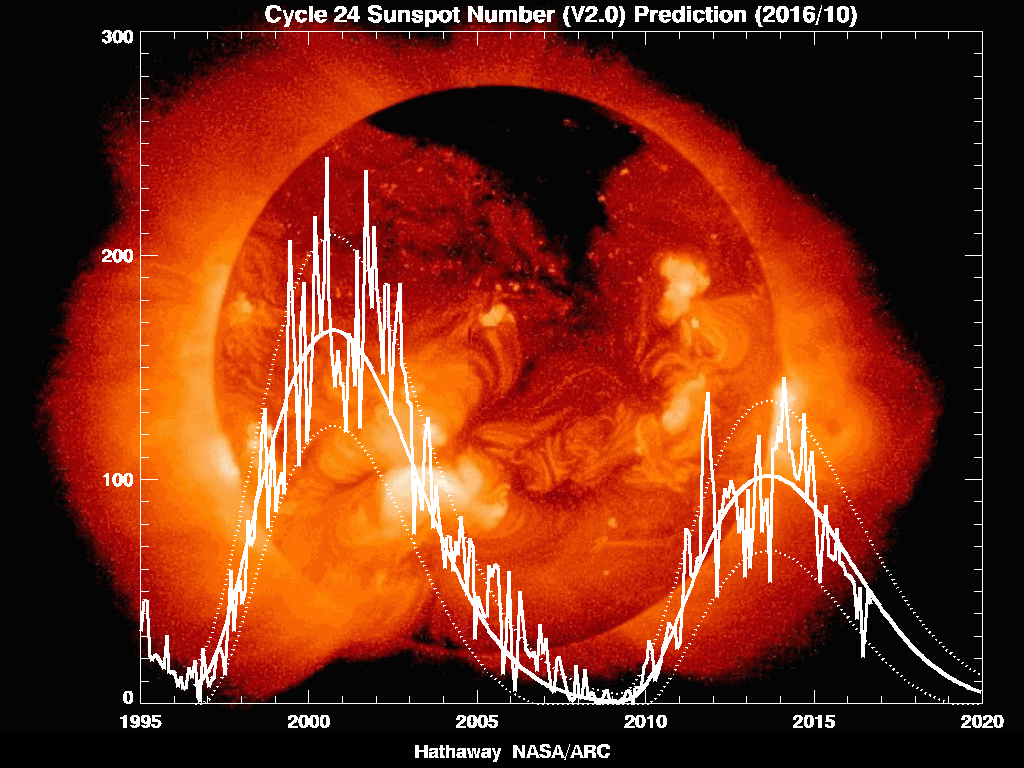
A few months ago I made an entry about the sun, and what a solar storm could do. NOAA made a prediction for the next solar cycle and mentioned the Carrington event in the article:

http://science.nasa.gov/headlines/y2009/29may_noaaprediction.htm

As you can see, the government clearly states that it could take ten years for a recovery from such an event, so I wasn't exaggerating about what could happen. For me, it is actually quite scary to see this new solar prediction in print. Also in the article is a good graph that clearly illustrates the Maunder Minimum, a time when glaciers expanded and rivers in Europe froze over in what was called the Little Ice Age. I'm sure you've seen the artwork showing ice skaters on the Thames. Scientists still do not know why that happened, and this article and it's graphs make me wonder if we are headed for another 'Maunder Minimum' period, as Gaia struggles to to counter the warming. I think it would be nice to see cooler temperatures and more precipitation, but the longer winters, shorter growing seasons, and possible famine wouldn't be
fun.

Carbon-14 dating in tree rings have shown that there are other 'minima' in recent history: Spörer Minimum (1450–1540)and Dalton Minimum (1790–1820). There has actually been 18 periods of sunspot minima in the last 8,000 years, and while some suggest that these periods are caused by a slowing of the sun's rotation, no one knows exactly why that would happen. It is interesting to think about. What we do know is that since 1996, the sun has been getting dimmer and the solar wind is 20% less than what it used to be. In the visible light spectrum, the sun is 0.02% dimmer, but in the ultraviolet spectrum, it is 6% dimmer. Referencing solar activity and sunspots, the sun is quieter now than it has been in the last 100 years. We are in what is referred to as a 'deep solar minimum'.

Tuesday, April 28, 2009

Life is a Salad

Pardon my absence from this space-it is a busy time of year, and we've had some real life interruptions that have taken us away from normal doings. I couldn't decide what image to display so of course I take that as an excuse to be a grandmother and brag about how wonderful my Jordan is by displaying a pictures. I titled this first picture "I love you this much", the second one is "Bear kisses", the third one is "Luvin' Jade"

Saturday, we spent the morning butchering chickens and cleaning up around the farm, mowing grass, etc., and then Saturday evening we had a NWGAA star party. It was a good meet-up, with two new members and their families visiting the field. The clouds dampened the viewing, but the company was good. I now have about 50 pounds of chicken in the freezer and about 38 birds left, 17 in the main coop and 21 in the old coop. I still have a few roosters to dispatch when they mature a bit, and I'll probably sell some more hens, but I envision a flock of about 25 birds or so when all is said and done. Today, I got 11 eggs, several were pullet eggs, which always amaze me. Soon, I will be awash in eggs. I hope I can sell them. On the way to town last week I saw a sign that read "Fresh Eggs $5 dozen" I hope *that* price holds! I usually sell mine for $2 dozen.


Sunday, we visited our daughter and granddaughter, and from her house, headed south to visit my father in law in the hospital, down to the Atlanta area. He had his cancer surgery and is recovering as expected. I've also had two doctor's appointments since I last blogged, saw my PCP today and my rheumatologist last week. I got some refills for our epi-pens, an appointment with a podiatrist, and of course a general checkup. I'll be waiting on my lab results, but the good news is that I am losing weight. The dietary changes I've made are working! I'm hopeful that as we ride our bikes more, even more pounds will come off. Since life has been a bit stressful, my RA has been flaring more than usual, but at least my allergies are not as distracting as last year. I'm trying to stay positive about things as I am finally believing, I mean truly believing, that attitude affects health. I suppose I've always believed that, but have never actively made a conscious effort to NOT be negative or to not worry about things. With no immune system to speak of, I could worry about all sorts of things, like catching a cold from being at the hospital, a re-emergence of MRSA in my body, or catching swine flu, but I'm making the decision to focus on all the positive things I am doing-eating healthier, losing weight, getting the right mix of vitamins, minerals, and anti-oxidants, and exercising.

Last week, while Skyguy was in a waiting room reading a newspaper, he saw an ad for a local breeder of shelties. After a brief discussion, it appears that we may have a new sheltie baby before 2010 rolls around. I contacted the breeder and we will be headed over the mountain to meet with her and see her dogs tomorrow evening. We will also need to discuss pricing so we can start saving money to buy the pup, etc. She will be breeding two of her bitches in the late summer and fall, so we are hopeful that between the two litters, the right puppy for us will be born. Take a few minutes to Ooh and Aah over the Shelties:

http://hornmtnshelties.com/

The remaining block of time has been spent gardening, planting flowers, watering in the seeds I've already sown, weeding, harvesting, etc. The Michihili cabbage is no more as I either ate it, froze it, or gifted it. I needed the space in the bed for peppers. It never did head up properly, but the quality was good nonetheless. I've eaten about a third of the Pak choy, taking two heads to my daughter. It looks like flea beetles are starting to attack it, so I need to cut the rest of it and bring it in. I love the stuff, so I will definitely plant more for the fall garden. I really wish I could freeze it and have it retain it's texture after being frozen. We are eating salad every day, mixing all the lettuces and spinach and greens. I throw in a few violet leaves, and soon I'll be adding nasturtiums and other flowers. To round off the salad I add asparagus shoots, broccoli florets, radishes, carrots, alfalfa sprouts, black olives, and we split a boiled egg. I'd love cheese and meat in it, too, but I'm staying away from that. I do, however, have some leftover grilled chicken, and since that is a healthy meat, I'm tempted to slice it and add that to tomorrow's dinner salad.

I got distracted there and started talking about food instead of gardening, but it is hard to grow food without talking about how good it is to eat! At any rate, I do have some sweet corn coming up, as well as about half of the pole beans. My tire stack is 4 tires tall and the potatoes are growing like mad. I sure hope they produce well. It is nice to be able to water the garden. With the old well, we barely had enough water for household use, but since we got the new well 16 months ago, the supply is more than I could have dreamed. I still don't waste water. I water by hand and only in the planted areas, not the paths, and I try to reduce the evaporative loss. I watch the weather and I won't water if there is a chance of rain. I have a rainwater catchment tank that I used to water from-it's a 330 gallon tank that catches water from the barn roof-but right now I need a new hose for it. I need to come up with a way to poke holes in a hose that will allow gravity fed water to seep from the hose. I think using some kind of metal straw to puncture the hose would work, but I have no idea of what I would use for that or practically how to accomplish what I envision.

We are going on a short vacation soon, and I have to get the rest of my tomatoes and peppers and squash in the ground and the pole beans strung before we leave. I started running string this evening, and tomorrow my friend is coming over to help with that. Maybe she will take some Pak Choi as payment. In a garden, there is always some task to do, and my vacation clock is ticking away. Last night, we spent time weeding Bermuda grass from the herb bed. While we were out and about this past weekend, Skyguy bought me a very nice lemon verbena plant. I'd been wanting another one since I stupidly killed the first one I had 20 years ago. That happened when I was first getting into herb gardening-a friend gave me a 3 foot tall shrub and I did not realize that it was a *deciduous* plant/tree and tossed it mid-winter thinking it was dead-DOH! This one is small, only about a foot tall, but it definitely has that heavenly lemon scent. We also bought salad burnett, summer savory(to go with all the beans), tricolor sage, purple sage, chocolate peppermint, horehound and anise hyssop. The herb bed is starting to come together. Seeds have sprouted and the seedlings are growing. The seedlings are small, two inch tall chives and basil, for example, but they will mature quickly.

Wednesday, April 01, 2009

The Mother of All Disasters

One hundred and fifty years ago on August 27, 1859, the world witnessed beautiful auroras that were seen as far south as the equator. This amazing light show continued for eight nights until September 7. In England, Richard Carrington, an amateur astronomer, was one of the first scientists to notice the intensely bright white light originating from a group of sunspots. Carrington also noted that the local magnetometers were erratic and off the scale. (A magnetometer measures the strength and direction of magnetic fields. They are useful in finding buried or submerged objects like shipwrecks or even submarines, and are standard equipment on spacecraft. In 1859, there were magnetometers at telegraph stations because the telegraph operated via electromagnetism.) Carrington correctly correlated this sunspot activity with the geomagnetic anomalies that were being recorded on magnometers as long distance communiques died and telegraph networks failed worldwide. Today, we refer to those eight days in 1859 as the Carrington Event. More recently, in 1989 in Quebec, there was another 'warning' solar event. Then, a brief plasma burst from the sun overwhelmed the power grid and high voltage current created a meltdown of the copper in the grid; Eastern Canada went dark. Luckily the storm was short-lived and US power companies helped restart the Canadian system.

You are probably wondering why the Carrington Event and the Quebec blackout is a big deal. Undoubtedly, the Earth has been bombarded with similar solar storms and we as a people and a planet have come through them just fine. However, if the Carrington Event happened again tomorrow, and it could, it is not an exaggeration to say that millions would die. It would be the planet's worst natural disaster in history.

How could that be in this interconnected global technological age? It is simple; our reliance on technology weakens us for this type of disaster. Here is what actually happens: During periods of increased solar/sunspot activity, the sun's coronal gases spit forth a plasma ball called a Coronal Mass Ejection or CME. CME's hurl through space like a gust of wind, and if they are directed at the Earth, the plasma interacts with the Earth's magnetosphere and atmosphere to create beautiful auroras and if it is powerful enough, some really nasty magnetic effects. To understand CME's, think of a small creek. During normal times, the creek slowly trickles on, like the solar wind does. Sometimes, during dry spells, the creek dries up and there is no flow whatsoever. Sometimes, there are flash floods that appear suddenly and do not last very long. That would be analogous to what happened during the Quebec incident. It was brief in duration and regional in effect. Sometimes, the flooding raises the water level and the flood continues for days. That would be analogous to the Carrington Event. As the Earth spun around, it was bombarded continuously by the CME from the sun, and telegraphs around the world were disabled as the storm lasted eight days.

The first casualties of an Earth directed CME will be satellites that are in Earth orbit. The plasma blasts disrupt gyroscopes on satellites making them unable to maintain orbital position. Once they lose Earth-lock, they lose the ability to transmit data, and there is no way scientists on the ground can communicate with the satellite, so they have to be abandoned. Secondly, high energy atomic particles bombard and fry electrical systems. Finally, as the upper atmosphere heats up from the plasma bombardment, the density of the lower atmosphere changes and that creates drag on satellites. Any or all of these things can happen to varying degrees in solar storms. Satellites would begin tumbling and would quickly lose orbital height. Communications would be lost. If GPS satellites are lost, oil platforms, aircraft navigation, cell phones, and other equipment that use GPS would become useless. The loss of communications and global positioning satellites alone would be an economic disaster. Solar disturbances wreak havoc on satellites quite frequently, much like earthquakes cause damage on Earth. However, one day, we will experience another Carrington Event-the equivalent of The Big One.

Within a minute and a half of the plasma burst hitting the atmosphere, power grids would fail from high energy particles like electrons overloading the lines which will heat up and melt essential grid hubs. In North America, there are about 300 key transformer hubs and if they are lost, the continental grid fails. These large currents will travel through the system like a massive lightning bolt, frying the electronics of anything not hardened in a Faraday cage. The world now relies so heavily on technology that the loss of power and equipment would have devastating consequences. Without power for control, drinking water treatment plants, sewage pumping stations, gasoline stations, supermarket refrigeration, medical equipment and other vital equipment will become non-functional.

Financial markets will plummet and the world's economy will flip-flop with the most technologically dependent countries taking the worst fall. For safety reasons, power plants are programmed to shut down with grid disruptions, so until the physical grid itself is restored, there would be no power generation. Nothing would change for months, probably years as melted transformers and hubs can only be replaced, not repaired. The few spare transformers kept in reserve would quickly be used, It takes a year to make one, and with high demand worldwide, obtaining more transformers would be nearly impossible in the short term. Government studies have suggested that if a large CME disabled the power grid in the United States, that power might not be restored for 4 to 10 years. YEARS.

Even when some systems are capable of receiving power again, there is no guarantee there will be any electricity to deliver. Almost all natural gas and fuel pipelines require electricity to operate. Coal-fired power stations usually keep coal reserves to last 30 days, but they rely on trains for coal delivery, and of course the trains are dependent on GPS and electrical switching and fuel pumping. Nuclear plants would be taken off line for safety reasons during the first minutes of the storm when the grid was lost and would be locked out until a consistent power source could be restored. After a period of say five years and millions of deaths, would there even be enough trained and knowledgeable people to operate the equipment?

Within minutes of the initial power loss, people would realize that without electricity, there is no clean drinking water or sewer service. That would soon lead to bacterial diseases like cholera and dysentery. Within a few days, there would be no food in the stores, because due to the inability to pump gasoline, no deliveries are made. Backup generators for medical care would last a few days, but after that, medical care loses 150 years of progress without lighting, lasers, sanitizers, diagnostic and monitoring equipment, etc. etc. With only rudimentary medical treatment, untold numbers would die. Of course, there would be no power for heating, cooling, or industry. After a few weeks, the supplies of medicine would run out, and without industry, there would be no way of making more or delivering the supplies where they are needed. In the course of several years, millions would die-from accidents and disease, from starvation and exposure, from criminal acts, and probably from war.

Other developed countries would be equally reduced to third world status. China's power grid system is even at a higher risk of failure due to the way the voltage is regulated, and European countries are so interdependent that a domino effect would incapacitate the continent almost immediately. The internet would survive in a diminished capacity, but only the military and governments would have hardened assets and battery capability to exchange information on a global scale. During solar storms, even shortwave radio is not reliable.

In the best of all possible worlds, our only hope is the ACE solar orbiting satellite(Advanced Composition Explorer) which could possibly give us 15 to 45 minutes of warning, depending on the speed of the ejection and the position of the satellite. If power companies have 15 minutes of warning, they can sometimes prevent damage or at least attempt to isolate grids to prevent a cascading loss. The problem is that ACE is already operating beyond it's expected lifespan-it was launched to study the solar wind back in 1997-and as it ages, it's detectors become less sensitive. It was not designed to measure a massive plasma ejection. The second and more serious problem is that previous large CME's, like the ones that precipitated the Carrington Event and the Quebec grid failure, traveled much faster than anticipated and arrived at Earth in less than 10 minutes. Even if ACE had been out there during those CME's, it would detect the particles, but not provide enough warning time to power companies or satellite controllers to take emergency measures.

In the worst of all possible worlds, the CME comes during a period of heightened solar activity, like what is projected to occur in 2012, near the Spring or Fall equinox. At the time of the equinoxes, Earth is oriented in such a way that the protective magnetic field is weakened and vulnerable to plasma strikes. Also, during this time of year, there is little demand for heating and cooling- it is 'off peak' if you will, and computers monitor the equipment on the grid. It is a time of year when manpower is minimal and should a spike occur, there may not be staff on hand to take immediate action before the plasma overwhelms the circuits.

What can you do to prepare? It is easy. Stay healthy and become more self sufficient. Reduce your dependency on technology and especially electricity. If a large CME does take out the power grid, power restoration will be sporadic at best, perhaps even managed as a rolling grid, where a certain area might have power one day a week or perhaps for one hour a day. Learn to grow your own food. Learn to hunt or fish. Learn which plants can be used as medicine. Go low tech whenever possible, for example, bike instead of drive. Learn to build a fire so that you can boil water. Most importantly, believe that it can happen, but don't panic if it does. Millions of humans before you survived just fine. Millions will die, but it doesn't have to be you.

Sunday, March 29, 2009

Eye of God Nebula


For me, the hardest part of blogging is choosing an image to complement what I am writing. I usually spend way too much time choosing pictures and deciding what I want the image to say. The last entry, about DNA, the Creator/God and the mysteries of the universe, prompted me to think of the Helix Nebula, which is also known as the Eye of God Nebula. I ultimately chose not to use that image, but I just couldn't let it go. I think it deserves it's own post, so it now has a home on my blog.

The Helix Nebula, NGC 7293, is a planetary nebula that is about 450-700 light years away in the constellation of Aquarius. A planetary nebula doesn't have anything to do with planets. They are formed when a red giant star is dying. The outer 'layer', the opaque 'skin', of a star is blown off and that allows radiation to illuminate from the star's core. That UV radiation ionizes the star's 'skin' gases as it radiates outward. It's all about the chemical reactions that stars undergo as they die. What you see could fancifully be called stardust; it is ionized gas from the former star. Timewise, these nebulae are rather short lived, recombining the gases as the core loses energy, creating a white dwarf star in about 10,000 years time. Dust to dust.

Friday, March 20, 2009

Light Pollution, Globe at Night


The International Dark-Sky Association defines light pollution as: “Any adverse effect of artificial light including sky glow, glare, light trespass, light clutter, decreased visibility at night, and energy waste."

Light trespass occurs when unwanted light enters one's property, for instance, your neighbor's security light that is not switched. Over-illumination is the excessive use of light. How many lights really need to be on in a skyscraper at night? Over-illumination wastes two million barrels of oil per day. (DOE stats) Glare is often the result of excessive contrast between bright and dark areas in the field of view. If you drive at night, you understand glare. Light clutter refers to excessive groupings of lights. Streetlight and sign lighting is often the culprit here. Finally, my pet peeve, sky glow, refers to the "glow" effect that can be seen over populated areas. It is the reflected light from all the pollution fixtures and practices listed above. The same effect (the Rayleigh effect) that makes the sky various shades of blue in the daytime will make the night sky various shades of gray/black. If the night sky is too light, too gray or white, then no stars can be seen. For astronomers, this is a real problem. As populations increase with urban and suburban sprawl, combined with cheap lighting and poor practices, more and more places are losing the stars, so to speak.

It is a common problem that few are aware of and yet, easy to eliminate. We simply must become more frugal and aware of the dangers of too much light. Lighting uses 25% of the world's energy, and one way to save energy and fiscal budgets is to turn out the lights.

Recently there was an article in the news stating the in the UK, the government will be paying women survivors of breast cancer if they worked at night. While some studies have shown an association between shift work and cancer, it is still under study. Mostly, it has to do with the hormones and chemicals, like melatonin, that our body uses or makes in the dark-at night. When the chemistry is off, diseases look for the chinks in the armor. Nighttime light pollution also affects people more directly. Night vision and visual acuity may deteriorate. Too much light gives some people migraines. The light itself is a subconscious reminder that people out there are moving, busying themselves in fun or work, and that knowledge can actually raise your blood pressure. Fatigue, stress, and even sexual dysfunction and infertility have all been tied to the health effects of light pollution. Even indoor fluorescent lighting can be considered light pollution, and it's effects have been documented in a number of studies.

Naturalists are concerned about how light pollution disrupts the natural cycles of light and dark and the negative effect on non-human animals is being documented worldwide. The artificial light disrupts animal navigation, changes predator-prey relationships, and alters the biochemistry of species. Here are some examples:

1) Studies suggest that light pollution around lakes prevents plankton, such as Daphnia, from eating surface algae, helping cause algal blooms that kill off plants and lower water quality.
2) Sea turtle hatchlings emerge from nests on beaches and move inland instead of out to sea. They don't really navigate by the moon, but they move to the lighter area by contrast. For millions of years, the dunes behind them were darker than the ocean before them. That is not true any longer. This is endangering to many species of turtles.
3) Migrating birds can be disoriented by lights on tall structures. Millions of birds are killed every year by flying into skyscrapers.
4) Night blooming flowers that depend on moths and nocturnal insects for pollination may be affected by night lighting. This can lead to species decline of plants that are unable to reproduce, and change the ecosystem.
5) Light pollution can negatively impact the migratory and breeding behaviour of frogs and salamanders, the canaries in the coalmine of our own world.

I wonder, too, if light pollution, especially sky glow, is responsible death of certain coral reefs.

The first thing you can do is to make yourself aware of your own situation. Globe at Night has easy charts so that you can compare the sky you see to what is really there. Between now and March 28th, people are observing the skies in their locations and then they will objectively report their location and the condition of the pollution. It is fun to participate. Hopefully it will open your eyes and make you aware of what you are missing. Once you have the facts, contact your local city council and try to get lighting changed or have special ordinances instated. You can do this!

In the meantime, participate in Earth Hour, which is on March 28. With observation and compliance, cities, corporations, and individuals around the world will collectively turn off the lights for one hour to save energy and protect the environment. Tell your neighbors and co-workers.

You can learn more here:
http://www.globe.gov/GaN/
http://www.globe.gov/GaN/observe_magnitude.html
http://www.darksky.org/mc/page.do